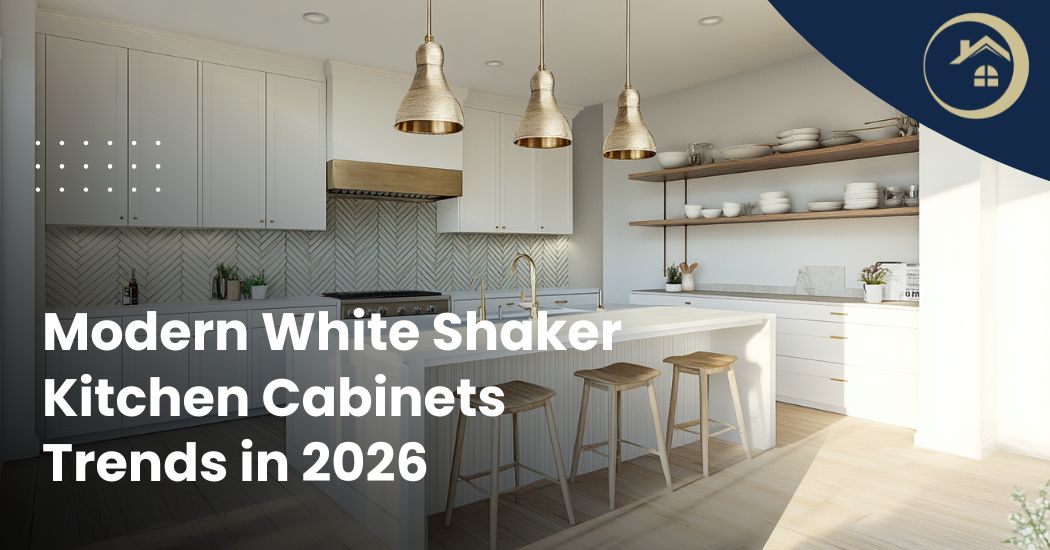
We’ve spent the last several months retooling our production lines for a new chapter of cabinetry, and the direction is clear. 2026 is the year of the Skinny Shaker—a refined, warmer evolution of the classic white Shaker look. At Parlun Building, we’re watching the industry move away from stark, hospital whites toward textured, livable luxury. If you’re planning a kitchen remodel this year, here’s what’s actually happening on the shop floor, and what you should know before you buy.
Key Takeaways
What’s changed in modern white Shaker cabinets for 2026:
Why Modern White Shaker Cabinets Still Dominate Kitchens in 2026
Modern white Shaker cabinets have stayed on top for the same reason the original Shaker style endured: simple lines, honest proportions, and an almost uncanny ability to flatter any countertop, floor, or hardware you pair with them.
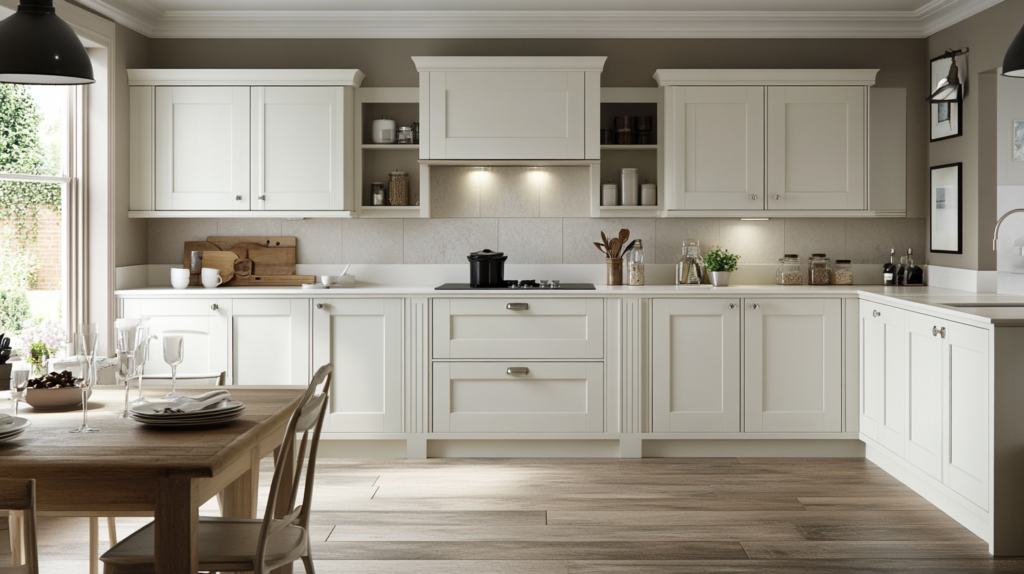
What has changed is their expression. The look has shifted from a traditional American classic into something more refined, warmer, and distinctly minimalist—closer in spirit to a Scandinavian apartment than a colonial farmhouse.
The rise of the Skinny Shaker
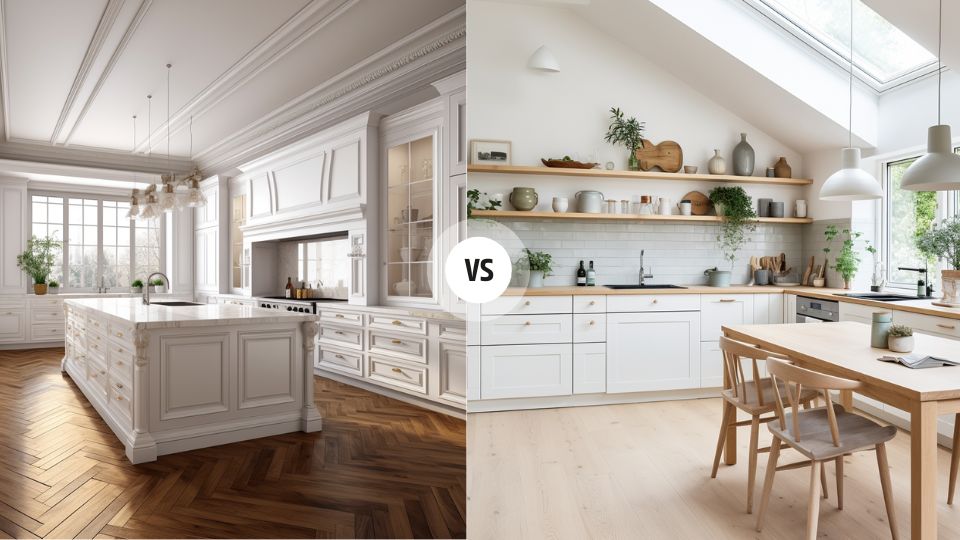
Traditional Shaker frames measured 2.5 to 3.5 inches wide. By 2026, modern versions have slimmed down to roughly 0.5 to 1 inch, a look often called Skinny Shaker or Micro-Shaker. The narrower frame preserves the subtle depth and shadow line that defines Shaker cabinetry while eliminating the heaviness of older designs. Visually, it lands somewhere between a Shaker and a slab door—ideal for homes that lean minimalist but don’t want the flatness of pure slab cabinetry.
Warmer whites replace hospital white
Color palettes are also shifting. The cold, clinical whites that dominated the 2015–2020 era have largely disappeared from high-end projects, replaced by creamy whites, oatmeals, and warm whites with a hint of gray—shades often described as mushroom white or greige white. Benjamin Moore’s Swiss Coffee and White Dove are two reference points designers return to again and again.
From a manufacturing standpoint, warmer whites put real pressure on paint performance. Low yellowing over time is non-negotiable—uneven yellowing is the fastest way to make a warm-white kitchen look dated rather than cozy. Matte and velvet-like finishes now dominate, and high-gloss surfaces are effectively gone from modern Shaker work.
Traditional vs. Modern White Shaker Kitchen Cabinets: A Quick Comparison
If you’re deciding between a classic Shaker look and the 2026 evolution, this is the shorthand:
|
Feature |
Traditional Shaker (pre-2020) |
Modern Skinny Shaker (2026) |
|
Frame width |
2.5″–3.5″ |
0.5″–1″ |
|
Color |
Pure white, cool-toned |
Creamy, mushroom, greige whites |
|
Finish |
Semi-gloss, high-gloss |
Matte, velvet, anti-fingerprint |
|
Hardware |
Polished chrome, brass knobs |
Brushed brass, matte black, push-to-open |
|
Core material |
Solid wood frame + panel |
Single-piece HDF with advanced coatings |
|
Overall feel |
Classic, somewhat heavy |
Minimalist, warm, architectural |
The Five Trends Reshaping Modern White Shaker Cabinets in 2026
Five shifts define the 2026 white Shaker kitchen:
1. Slimmer profiles, cleaner lines
As noted above, the 2.5- to 3.5-inch traditional frame is being phased out in favor of half-inch to one-inch profiles. The result is a lighter, more urban aesthetic that slots naturally into city apartments in places like Manhattan or London, without the rustic undertone of traditional Shaker work.
2. Honest, pragmatic materials
Single-piece HDF construction with advanced tactile finishes has emerged as a global manufacturing standard. HDF carving is replacing solid-wood frame-and-panel assemblies in many premium lines for one practical reason: hairline cracks from solid-wood movement are the single biggest source of complaints in high-paint white cabinetry, especially in regions with significant humidity or temperature swings.
The goal has shifted from glossy smoothness to a soft, velvet-like touch. Anti-fingerprint, scratch-resistant matte coatings let white doors diffuse light gently instead of bouncing harsh glare, which is a real problem in homes with large windows or strong downlights.
3. Mixed materials over all-white schemes
All-white kitchens are rarely the first choice anymore. The most requested layouts at Parlun Building pair warm-white Shaker uppers with rift-sawn white oak or walnut bases or islands. The logic is simple: white is responsible for brightness; wood provides warmth, grain, and tactile depth. The resulting “lighter above, heavier below” balance has become a default in 2026 model homes.
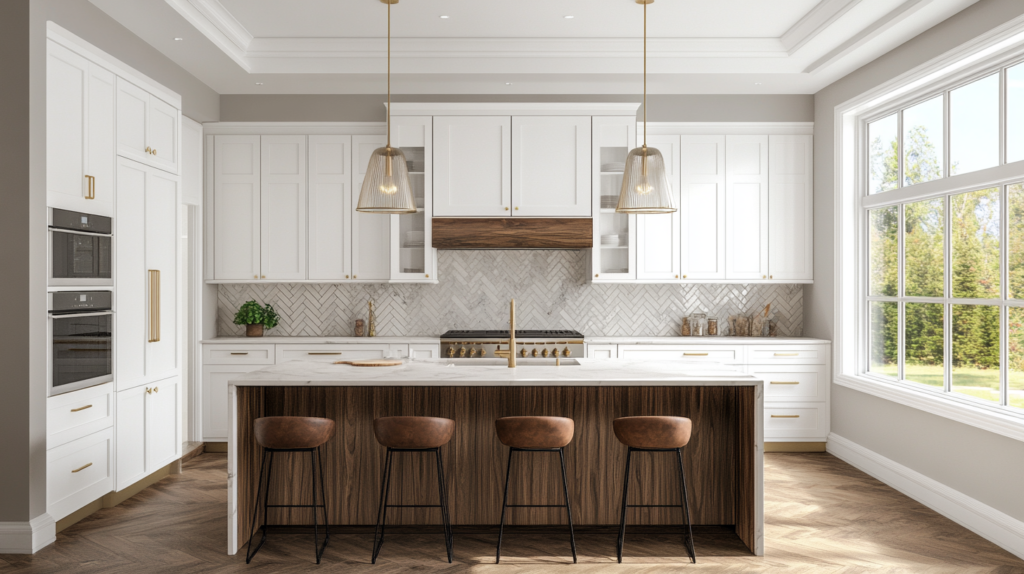
Sage green is also having a moment as a warm neutral, particularly in modern farmhouse kitchens. A forest-green island with a quartz top and a deep navy accent can add a pleasing twist without breaking the calm of a white Shaker scheme.
4. Integrated lighting and invisible hardware
Modern Shaker frames are now frequently designed with a subtle inner ledge that conceals an LED strip, hiding the light source while enhancing door depth. Hardware is going the opposite direction from the chunky pulls of the late 2010s: extra-long, ultra-slim pulls that run two-thirds of the door height, push-to-open mechanisms for a completely clean face, and mixed metals where brushed brass sits comfortably next to matte black or polished nickel.
5. Performance coatings become standard
Anti-fingerprint technology and antibacterial coatings, which were previously exclusive to high-end products, are now a standard feature on most premium white Shaker cabinetry. For white finishes this matters daily—a smudge-resistant door is the difference between a kitchen that photographs beautifully on day one and one that still does three years later.
Designing Around Modern White Shaker Cabinets: Countertops, Backsplashes, and Islands
Think of Skinny Shaker cabinets as a canvas. What surrounds them is what separates a competent kitchen from one that belongs on a magazine cover.
Slab-on-slab countertops and backsplashes
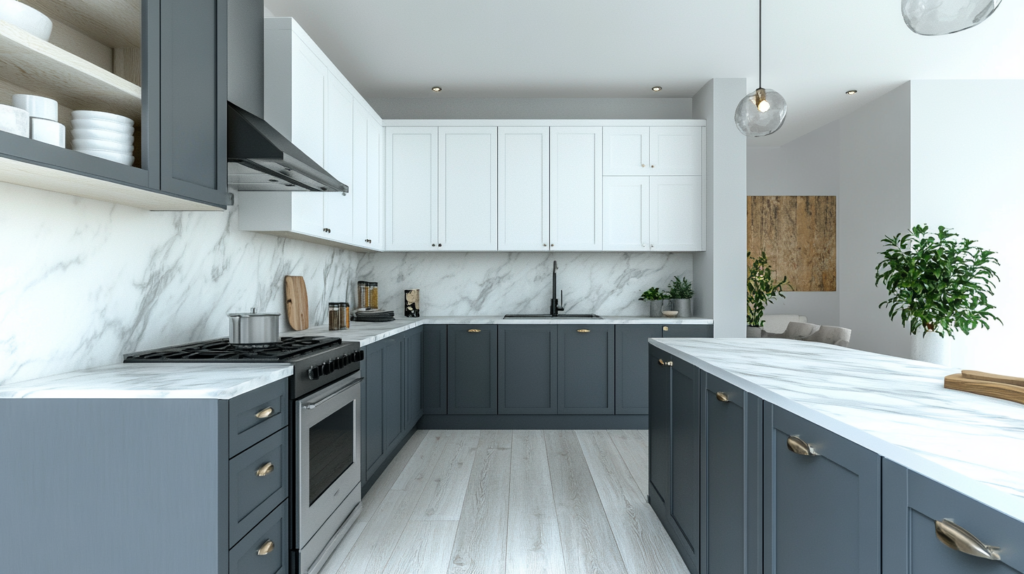
The defining countertop trend of 2026 is slab-on-slab. Instead of a stone top meeting a tiled backsplash, the same stone (usually a 2 cm slab) runs up the wall to the underside of the upper cabinets—or all the way to the ceiling. Modern white Shaker doors already carry strong horizontal and vertical lines; small tiles behind them create visual noise. A full-height slab becomes a quiet backdrop that lets the slim Shaker rhythm read clearly.
If the stone has visible veining, bookmatching the pattern so it flows vertically from the countertop up the wall creates a waterfall effect that’s become a signature detail in American luxury homes. Icy gray veining is giving way to warmer tones—quartz and quartzite with champagne, copper, or subtle rust veining feel far more current.
Honed and leathered finishes over polished stone
Surface finish matters as much as pattern. Honed and leathered stone finishes are steadily replacing high-gloss polishing. Low-reflection stone pairs naturally with velvet-matte white cabinetry, while polished stone tends to read plasticky next to matte doors. Matte on matte reads as fine bone china; matte against high gloss reads as a mismatched showroom.
Smart material choices: quartzite, “hard marble,” and porcelain slabs
Taj Mahal quartzite is a favorite for this style—harder than marble but with marble’s soft, slightly translucent warmth. Its gentle champagne veining softens the coolness of white cabinetry without overpowering it.
Large-format sintered stone and porcelain slabs have also come a long way. Modern 6 mm porcelain can replicate leathered finishes convincingly, is heat- and stain-resistant, and is thin enough for full-wall application without adding structural load. What to avoid: the heavy, chaotic quartz patterns that peaked a few years ago. Current preference is for faint, whisper-like veining that reads as calm rather than busy.
Two installation details worth specifying
Islands are becoming furniture
The 2026 island is less a work surface and more a piece of architectural furniture. Set-back bases, softened or curved edges, and contrasting wood tones turn the island into the kitchen’s social center. Pairing white Shaker perimeter cabinets with a walnut or dark-wood island adds visual weight and grounds the room.
Tall Shaker cabinets are also increasingly used to conceal small appliances—coffee machines, toasters, stand mixers—behind closed doors. This hidden kitchen approach keeps the space calm and uncluttered between meals, and it’s especially popular with modern American households who entertain in the kitchen.
Flooring, Lighting, and Soft Details that Complement Modern White Shaker Kitchen Cabinets
Flooring returns to natural warmth
Wide-plank oak floors in honey tones or light wood remain the best companion for a white Shaker kitchen, counterbalancing the coolness that white can bring. Checkerboard flooring is also making a comeback in 2026—but in softer beige-and-light-gray pairings rather than the stark black-and-white of earlier eras.
Lighting becomes sculpture
Pendants over the island are growing larger and more statement-driven, with the fixture itself treated as sculpture. Plaster, frosted glass, and handmade ceramics are especially popular, and the light they throw should feel warm and diffuse rather than sharp.
Mixed metals are the new uniform
Mixing metals is no longer a mistake to avoid; it’s a technique to master. A common 2026 combination: brushed brass on the cabinet doors, matte black or polished nickel on the faucets. The result feels relaxed and collected, precisely because it doesn’t look overly coordinated.
Soft textiles bring the kitchen to life
Café curtains and linen Roman shades are returning to kitchen windows, softening the structured lines of Shaker cabinetry. For seating, bar stools with cane or leather elements help a white kitchen feel lived-in rather than showroom-perfect.
The Takeaway: A Timeless Style, Updated for 2026
The real appeal of modern white Shaker cabinets is what we’d call a timeless evolution. They carry forward the structural honesty of traditional craftsmanship while embracing the slim proportions, velvet finishes, and warmer whites that define 2026. That balance is why they feel both warm and refined at the same time—and why they’ll continue to look right a decade from now.
Like a clean, luminous canvas, they brighten the space, enhance openness, and work with almost any high-end material you pair them with. That makes them not just a safe choice for a remodel, but a genuine design investment that holds property value over time.
Thinking about modern white Shaker cabinets for your own kitchen?
Shaker cabinetry is one of Parlun Building’s strongest specialties. Whether you’re a homeowner planning a single remodel or a contractor specifying multiple projects, we can help you match the right frame profile, finish, and material to your space—at pricing that stays competitive even for premium coatings.