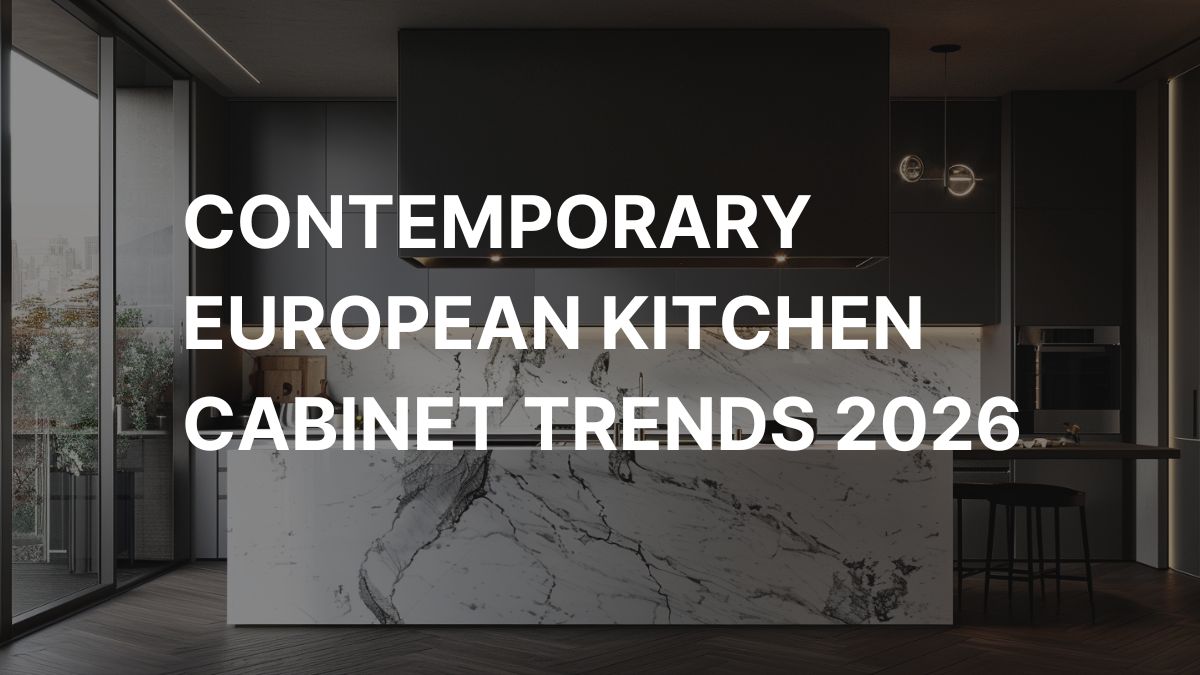
The past decade of European kitchen design was defined by restraint: white lacquer, cool gray, flat surfaces, and the quiet confidence of saying nothing. That language is not disappearing, but it is evolving. In 2026, the real shifts in contemporary European kitchen cabinets are happening in three places: materials, technology, and geometry. Understanding what’s driving them matters more than knowing what’s trending.
Key Takeaways
Contemporary European Kitchen Cabinets: From Cool Neutrals to Tactile Warmth
The dominance of pure white and cool gray in European kitchen cabinetry has been well documented in our earlier coverage of minimalist palette design. What is happening now is not a rejection of minimalism but a maturation of it.
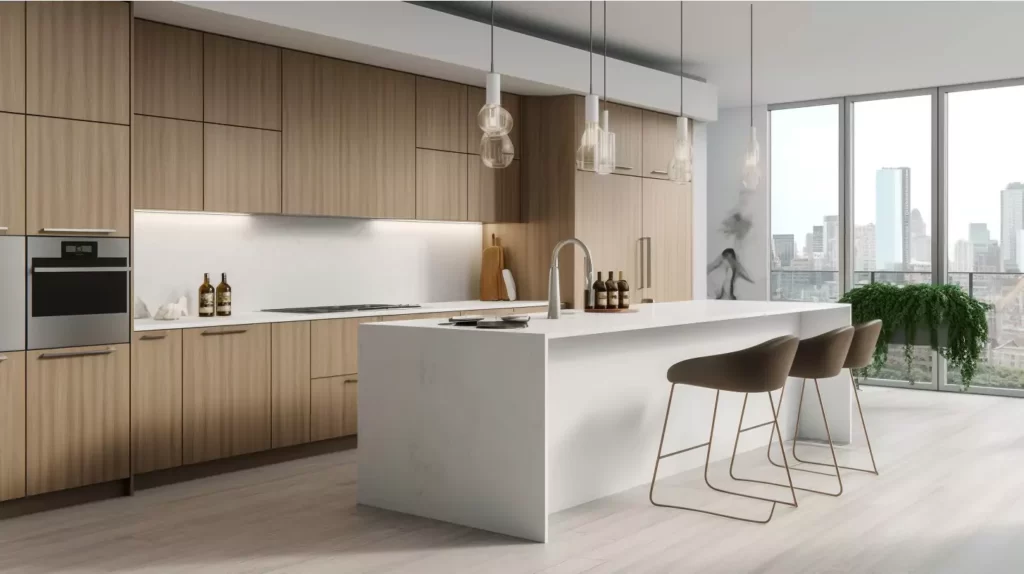
Warm neutrals—mushroom, taupe, cashmere, and greige—are replacing cool whites as the default base palette. These tones carry more visual depth than white and feel more grounded than gray, without introducing the maintenance demands of darker finishes. In the U.S. luxury kitchen market specifically, visual fatigue with cool-toned kitchens has accelerated this shift. In conversations with specifiers at recent industry events, designers consistently report stronger client preference for palettes that feel residential rather than commercial—a pattern also reflected in recent KBIS and Salone del Mobile reporting.
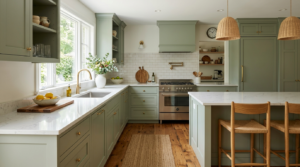
Accent colors in 2026 European cabinetry lean toward tones with gray undertones: muted navy, olive, and deep forest green are appearing most frequently on islands and tall accent cabinets. These are not saturated statement colors—they read more like the color of a lake at dusk than a painted surface, carrying weight without aggression.
The two-tone kitchen cabinet approach remains the dominant compositional strategy. The most resolved versions pair dark wood grain base cabinets with warm-neutral uppers, sometimes introducing a curved island in a contrasting tone as a third element. The logic is layering rather than contrast for its own sake.
At a glance, the 2026 European kitchen color direction looks like this:
|
Role |
Tone Family |
Signature Colors |
|
Base palette |
Warm neutrals |
Mushroom, taupe, cashmere, greige |
|
Accent |
Muted deep tones |
Muted navy, olive, deep forest green |
|
Two-tone strategy |
Dark wood + warm neutral |
Walnut base + cashmere upper |
The Return of Dark Wood and Natural Stone—Done Differently
Light oak dominated European cabinetry for several years. In the 2026 trend for European kitchen cabinet design, darker woods are returning—walnut, roasted oak, and deep-toned teak—but the way they are being used has changed.

The shift is away from uniform, perfectly finished wood surfaces toward grain that reads as genuinely natural. Knots, mineral streaks, and tonal variation are being preserved rather than sanded out. This reflects a broader design philosophy sometimes described as “imperfect beauty”—the acknowledgment that materials from nature do not need to be corrected to feel luxurious.
At the surface treatment level, high-gloss finishes are giving way to velvet matte and super-matte cabinet surfaces. These finishes are softer to the touch, significantly less prone to showing fingerprints, and align more naturally with the organic warmth of the current color direction.
The most technically demanding development in this space is the use of ultra-thin sintered stone cabinet doors. Manufacturers are now combining 3–6mm sintered stone with aluminum honeycomb cores to produce cabinet fronts that carry the visual weight of stone while remaining light enough for standard European hinge systems.
Stone is no longer confined to countertops and backsplashes—it is becoming a door and panel material, and the results at the high end of the market are qualitatively different from anything achievable with laminate or veneer alone.
|
Wood Veneer |
Laminate / PET |
Sintered Stone |
|
|
Appearance |
Natural grain, warm |
Consistent, uniform |
Stone-like, high-end |
|
Thickness |
0.6–1mm surface layer |
0.3–1mm surface layer |
3–6mm panel |
|
Core material |
MDF or plywood |
MDF or plywood |
Aluminum honeycomb |
|
Heat resistance |
Moderate |
Moderate |
High |
|
Scratch resistance |
Low–moderate |
Moderate |
High |
|
Maintenance |
Needs careful cleaning |
Easy wipe-down |
Easy wipe-down |
|
Best for |
Warm, organic aesthetics |
High-use, budget-conscious |
Ultra-premium, statement surfaces |
Fluted and slatted cabinet surface treatments are also gaining ground. Vertical or horizontal ridges introduce light and shadow variation across the cabinet face, giving a textured depth that flat surfaces cannot achieve. These profiles place higher demands on edge-banding and machining accuracy, which is why they remain more common in custom and semi-custom work than in production cabinetry.
Invisible Technology: The Contemporary European Kitchen That Disappears
The defining ambition of high-end European kitchen design in 2026 is a kitchen that visually ceases to exist when it is not in use. As open-plan layouts continue to expand in the U.S. residential market—with kitchen, dining, and living areas merging into single great rooms—the pressure to make the kitchen blend into the living space has intensified.

The Four Technologies Making the “Invisible Kitchen” Possible
These systems redefine a kitchen’s appearance when not in use—and increasingly, that expectation is nothing at all.
Soft Geometry in Contemporary European Kitchen Cabinets: The End of the 90-Degree Corner
Sharp 90-degree angles are becoming a marker of older or more budget-oriented cabinetry. In contemporary European kitchen design, curved forms are appearing across island corners, cabinet transitions, wall cabinet undersides, and countertop edge profiles.

The functional case for this shift is straightforward: curves are safer in compact kitchens and more comfortable at high-traffic points like island corners. The design case is equally clear: curves distinguish bespoke cabinetry from production work in a way that material alone cannot. A continuously curved island side panel requires a level of forming, machining, and edge-banding precision that mass-produced cabinetry cannot consistently deliver.
Countertop edges are following the same direction. Bullnose profiles and softly stepped edges with gentle curvature are replacing the sharp bevels that defined the previous decade. At the cabinet door level, ultra-slim European-style frames are replacing the wide traditional frames still common in American production cabinetry, bringing the door profile into alignment with the overall geometric language.
Hardware as Architecture
In handleless kitchen designs—which remain the dominant direction in contemporary European cabinetry—hardware has shifted from functional necessity to architectural detail. The pieces that are visible are treated with the same intentionality as the cabinets themselves.

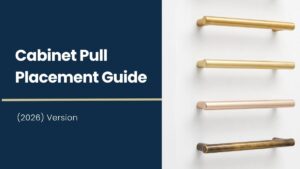
Warm metallic finishes are leading: brushed brass, champagne gold, and antique bronze are appearing where chrome and polished stainless dominated previously. These finishes align naturally with the warm neutral palette and dark wood direction described above.
Where handles are present, the preference is for ultra-slim CNC-machined J-pull or U-pull profiles integrated along the top edge of cabinet doors. These details are typically finished to match or deliberately contrast with faucet and fixture finishes—brushed brass cabinet pulls against brushed black nickel island accessories, for example. This kind of intentional asymmetry signals design confidence rather than a failure of coordination.
Corner carousel systems, tall pull-out units, and drawer runners are expected to operate with consistent soft-close function and zero play. At the high end of the market, this is no longer a differentiator—it is a baseline expectation.
Sustainability as Specification
The European market has been ahead of the U.S. on sustainable material standards for several years. In 2026, those standards are becoming the default in American high-end projects rather than optional credentials.
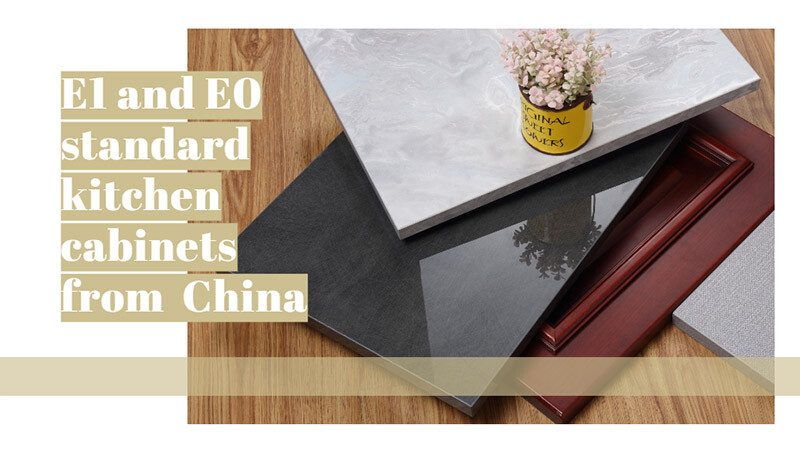
When specifying contemporary European cabinetry for high-end projects, the certifications and standards worth verifying include:
Circular design principles are also entering the conversation. Cabinets designed for disassembly—where door fronts, hardware, and boxes can be separated and replaced independently—extend the functional lifespan of the installation and reduce material waste at renovation. This aligns with the European regulatory direction and is beginning to influence how U.S. designers specify custom cabinetry.
Closing: A Value Shift, Not a Style Shift
The 2026 direction in contemporary European kitchen cabinets is not a style shift so much as a values shift. Warmth over sterility, texture over smoothness, integration over visibility, and longevity over trend. The cabinets themselves are doing less visual work—and the materials, the geometry, and the technology around them are doing more.
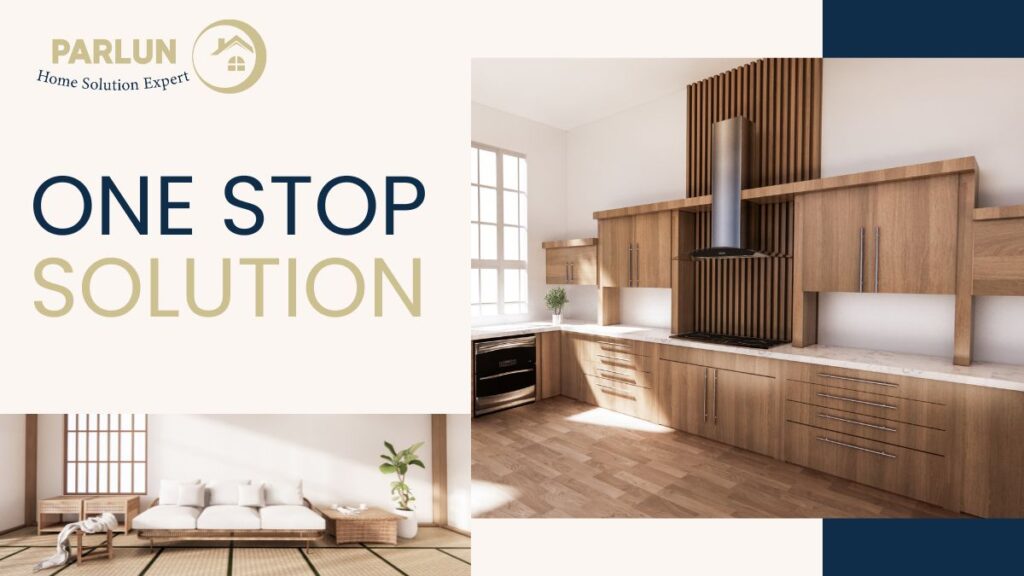
Bring These 2026 Contemporary European Trends Into Your Next Project
At Parlun Building, these are not trends we are responding to after the fact. Sequence-matched veneers, laser edge banding, sintered stone panel construction, and sensor-integrated hardware are part of how we build every day.
Whether you’re an interior designer, an architect, or a homeowner planning a contemporary European kitchen project, here is how we can help you move forward:
Contact our team today—early-stage conversations are where we can add the most value to your contemporary European kitchen project.