If your wall cabinets stop short of the ceiling, the gap can feel unfinished. These decorating ideas for above kitchen cabinets help you use that space without crowding it. Start by measuring the gap, then choose pieces you can see from below and lift down easily for cleaning. If you prefer to keep the cabinet tops clear, you can leave the gap open, add crown molding, or install cabinets that reach the ceiling.
Quick Summary of Above Kitchen Cabinet Decor
If you want the short version, above kitchen cabinet decor works best when you treat the space like a small styled shelf rather than a storage dumping ground.
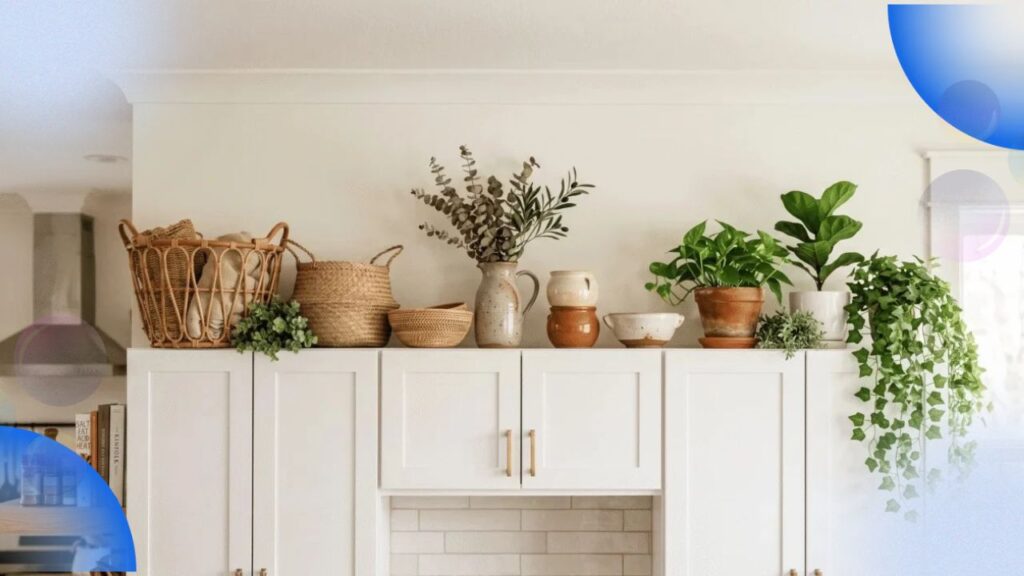
A gap of around ten inches or more can work for a small display if the pieces fit comfortably. Leave it empty when the gap is shallow or your kitchen already feels busy. Simple decorating ideas for above kitchen cabinets start with a few larger pieces and a color palette drawn from your countertop or backsplash. Baskets, ceramics, framed art, trailing greenery, and warm lighting all perform well when kept intentional. Modern kitchens need extra restraint, so lean on negative space and repeated shapes. Line the cabinet tops to control grease and dust, and dust every month or so. Crown molding can close a shallow gap, while cabinets that reach the ceiling can turn a taller gap into storage.
Should You Decorate Above Kitchen Cabinets
Deciding whether to decorate above kitchen cabinets comes down to four things. First is ceiling height. Eight foot ceilings leave a modest gap that suits a light display, while nine and ten foot ceilings allow taller, bolder pieces. Second is cabinet height. Standard thirty and thirty six inch uppers leave more room than forty two inch cabinets, which sit close to the ceiling.
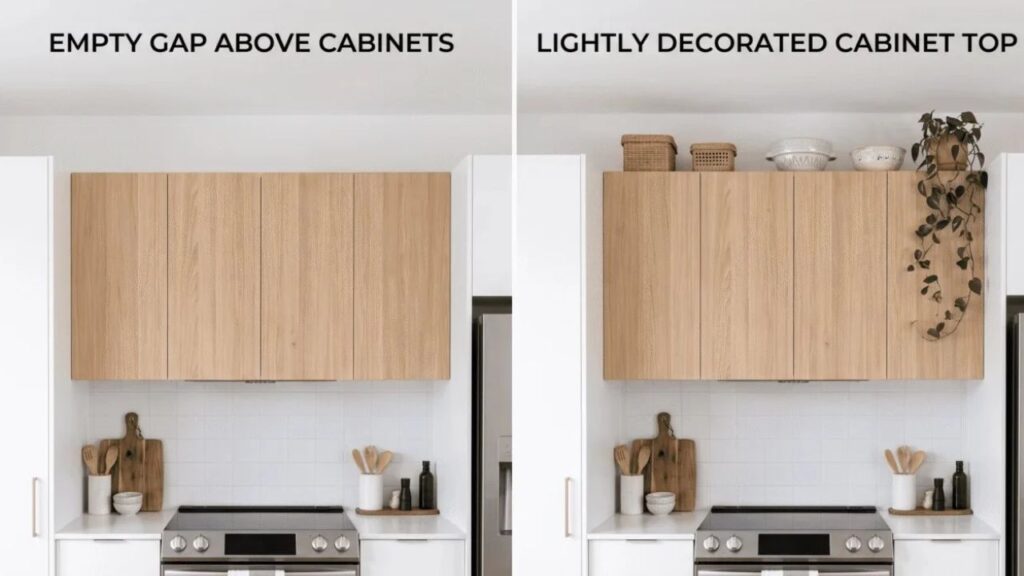
Room size matters too. In a small kitchen, a styled top draws the eye up and makes the ceiling feel higher, while in a large kitchen the same ledge can look lost if the pieces are too small. The last factor is the gap. A shallow gap under eight inches rarely looks good with objects crowded in, so leaving it clean is often smarter. Run through this quick guide first.
|
Your situation |
Better choice |
|
Gap of ten inches or more with eight foot or taller ceilings |
Decorate with a few large pieces |
|
Shallow gap under eight inches |
Leave it empty or add crown molding |
|
Busy kitchen with open shelving and lots of color |
Leave it empty to calm the room |
|
Plain kitchen that feels top heavy or unfinished |
Decorate to soften and balance it |
|
Very high ceilings above nine feet |
Use tall art or oversized vessels |
How to Measure and Plan the Space Above Cabinets
Before you buy a single basket, measure the space above your cabinets. Grab a step ladder and record three numbers. Measure the height from cabinet top to ceiling, the depth of the cabinet top front to back, and the length of the run. These numbers stop you buying pieces too tall to fit or too deep to sit safely.
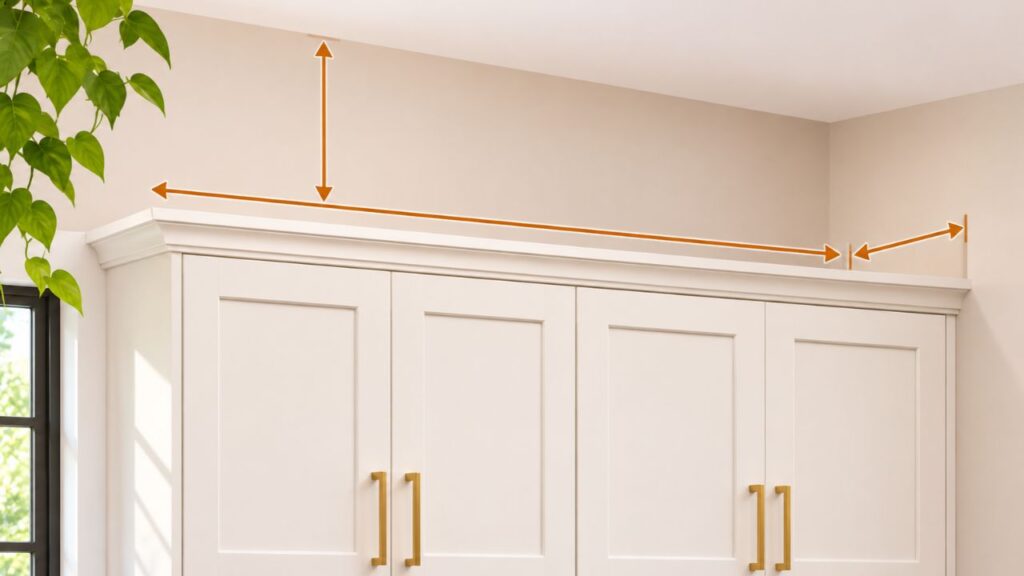
Scale is where most people go wrong. As a rule, your tallest object should fill about two thirds of the gap and leave breathing room above it. Set each piece back an inch or two from the edge so nothing looks like it might tip. Style for sightlines, since decor that looks great from across the room can vanish up close. Pull one or two colors from your cabinets or backsplash and repeat them up top to tie the display to the kitchen.
Measurement checklist
How to Decorate Above Kitchen Cabinets Step by Step
Here is how to decorate above kitchen cabinets in six simple steps, from a clean top to a final check.
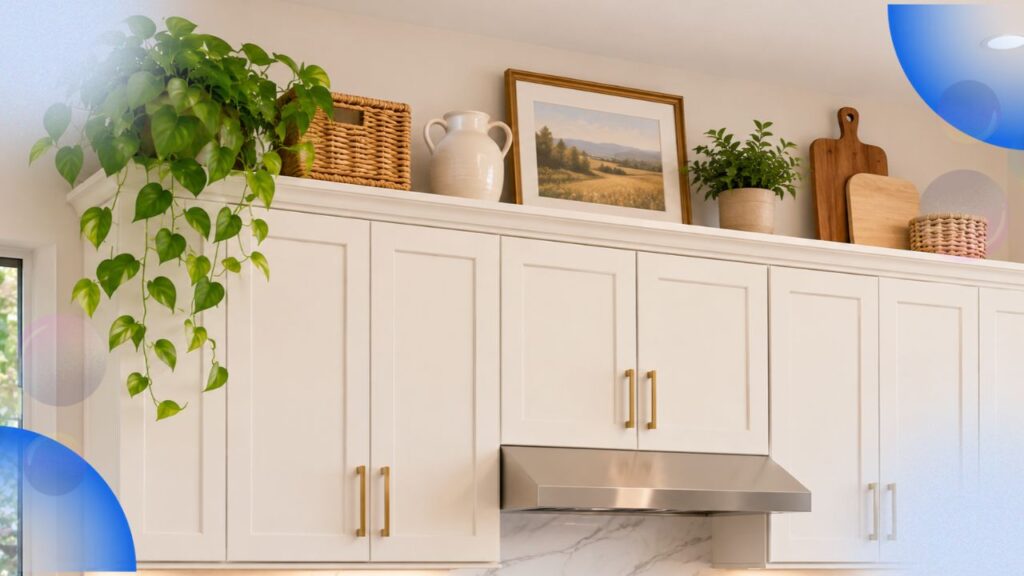
Check the display every few months. Swap one piece to match the season, and dust as you go, so the space stays tidy.
Best Above Kitchen Cabinet Decor Ideas
This is where above kitchen cabinet decor gets fun. The ideas below cover most styles and budgets, so keep the scale and color rules in mind and stop once the space looks intentional.
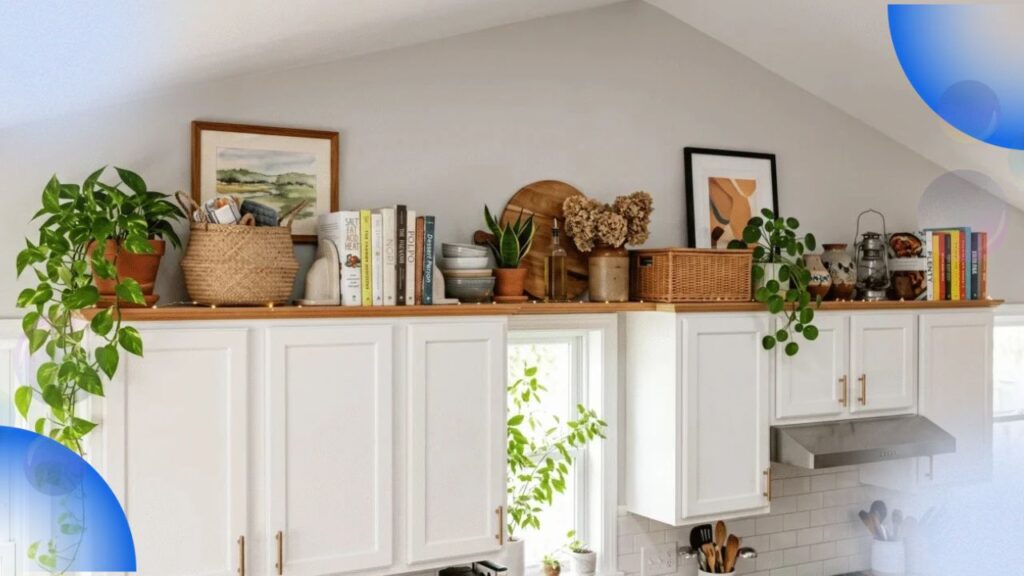
Trailing Plants and Greenery
Plants above kitchen cabinets soften hard lines and add life. Faux pothos or ivy works best, since real plants struggle in low light and are hard to water up high. Avoid stiff, plastic looking stems.
Woven Baskets for Warmth and Storage
Baskets above kitchen cabinets bring texture and hide lightweight, seldom used items. Group two or three in similar tones. Avoid a long row of identical baskets, which looks like filler.
Framed Art and Leaning Prints
Art above kitchen cabinets adds personality fast. Lean framed prints against the wall and overlap them for depth. Choose larger frames over small ones, and skip delicate paper that grease could damage.
Ceramics and Statement Vases
A few large ceramic vases or bowls create a curated display with little effort. Vary the heights and keep the palette tight. Avoid tiny trinkets, which get lost and gather dust.
Cookbooks in Small Stacks
A short stack of cookbooks adds color and a lived in feel. Turn a nice cover outward or stand one on an easel. Avoid tall towers that are hard to dust.
Vintage Kitchenware and Collectibles
Vintage kitchenware such as enamel pitchers, copper pots, or old crocks suits farmhouse kitchens. Cluster a few related pieces together. Avoid mixing too many finishes, which turns charm into noise.
Warm Lighting Above the Cabinets
Lighting above kitchen cabinets is an underused trick. A hidden LED strip along the cabinet top washes the ceiling with a soft glow at night. Avoid harsh, cool white strips.
Wallpaper or Paint Behind the Display
Painting or wallpapering the wall behind the gap gives your decor a backdrop and hides scuffs. A deep or patterned color adds depth. Avoid busy patterns that compete with your objects.
Trays to Group Small Pieces
A flat tray or wooden board corrals small objects into one tidy group instead of a loose scatter. It also makes cleaning easier, since you lift the whole tray.
Decorative Molding for a Built-In Look
Crown molding gives bare cabinet tops a finished edge. The next section covers profiles, sizing, and installation.
Kitchen Cabinet Crown Molding Ideas
Kitchen cabinet crown molding finishes the top edge of wall cabinets. It can frame the cabinet tops while leaving a gap above them, or span a shallow gap all the way to the ceiling. Choose the profile, size, and finish to suit the cabinets and the space above them.
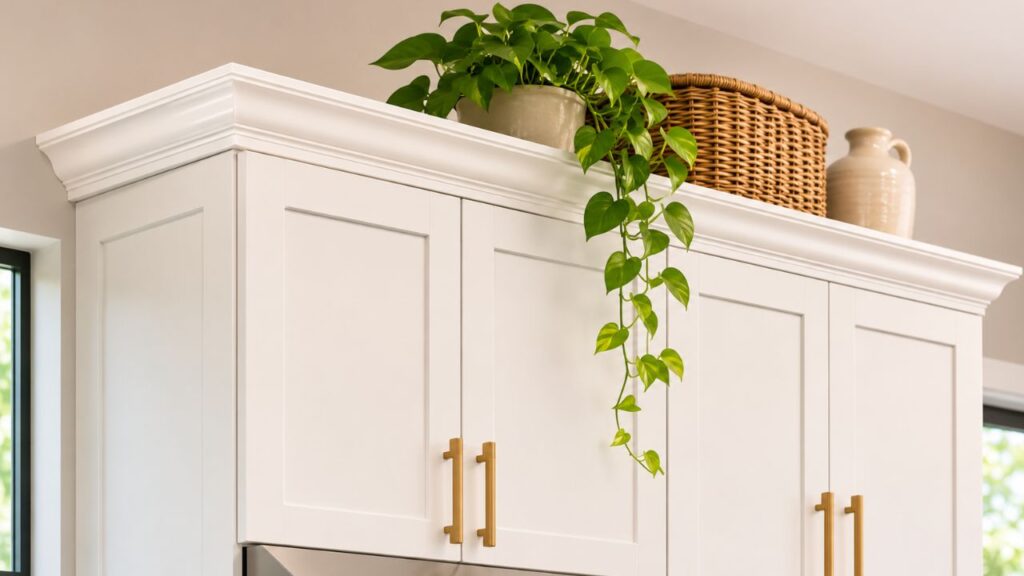
Choose a Profile That Fits Your Cabinet Style
A simple cove or flat profile suits shaker and modern doors. A stepped or built up profile, made from two or three pieces, suits classic and traditional kitchens. Keep the lines plain on flat panel cabinets, and save detailed profiles for raised panel doors.
Pick a Size That Suits the Gap
Compare the profile’s installed height with the gap you measured above the cabinets. Taller ceilings can carry a deeper profile. To test a size, hold a short sample piece in place and look at it from across the room. A deeper crown can also hide a slim LED strip on top of the cabinets.
Use a Riser When the Gap Is Tall
If you want the trim to reach the ceiling and the crown is too short on its own, add a riser panel beneath it. The riser lifts the molding closer to the ceiling and keeps the profile in proportion. Paint the riser and the molding the same color, so they look like one trim piece.
Choose a Finish
Paint or stain the molding to match the cabinets for a built in look. If your cabinets are natural wood, use a stained molding in a matching tone. Match the ceiling color instead if you want the molding to blend away. Use the same sheen as the doors, so the two parts look like one piece.
Fit It for a Clean Result
Ceilings and walls are rarely perfectly level, so measure in several spots before you cut. Use caulk to close small gaps, then paint over it. Turn the molding back to the wall at each open end of a run, so no raw cut edge shows. Ask a carpenter or cabinet installer to fit it if you are not confident with angled cuts.
Kitchen Cabinet Trim Options
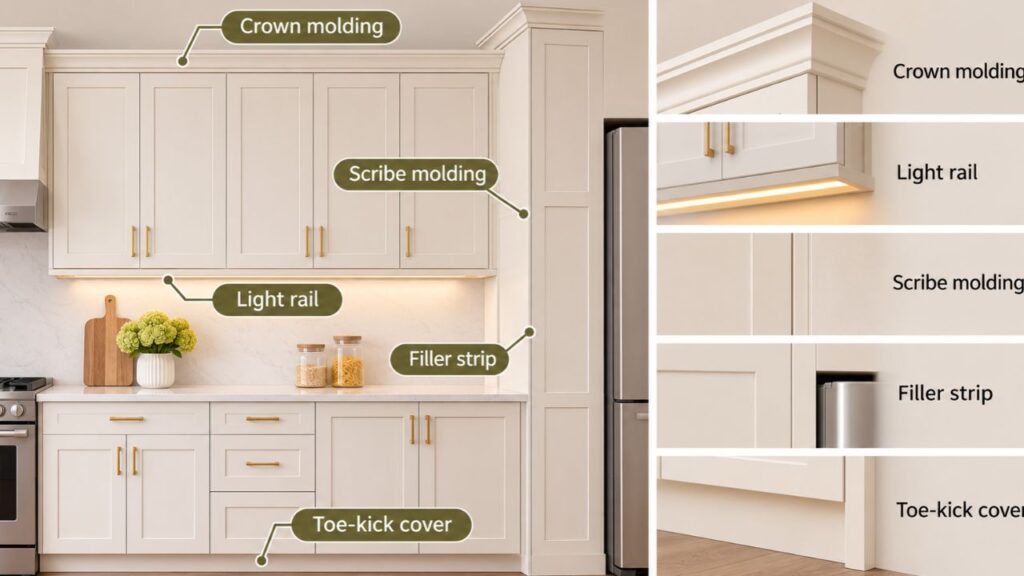
Kitchen cabinet trim covers the small gaps and rough edges where cabinets meet walls, ceilings and floors. Four pieces do most of the work.
Light Rail Molding
Light rail is a thin strip fixed to the bottom edge of the wall cabinets. It hides under cabinet lighting and the plain underside of the cabinet box. Paired with crown molding on top, it makes the wall cabinets look framed at both ends.
Scribe Molding
Scribe molding is a thin, flexible strip that covers small gaps where a cabinet meets an uneven wall, ceiling or floor. You cut it to follow the line of the surface, then paint or stain it to match the cabinets. It suits hairline gaps, not wide ones.
Filler Strips
A filler is a flat strip of cabinet material that closes a gap between a cabinet and a wall, or between two cabinets. It also keeps doors and drawers from hitting a wall or a neighboring handle. Fillers can be cut to fit, so choose the same finish as the doors.
Toe Kick
The toe kick is the recess at the bottom front of a base cabinet. It gives your feet room when you stand close to the countertop. A toe-kick cover finishes the recess and can hide adjustable cabinet legs. Match the cover to the cabinets or choose a darker finish that blends into the shadow.
|
Trim piece |
Where it goes |
What it does |
|---|---|---|
|
Crown molding |
Top of wall cabinets |
Finishes the top edge and can close a shallow gap |
|
Light rail |
Bottom of wall cabinets |
Hides under cabinet lights |
|
Scribe molding |
Cabinet edge at a wall, ceiling or floor |
Covers small gaps |
|
Filler strip |
Between a cabinet and a wall, or two cabinets |
Closes wider gaps |
|
Toe-kick cover |
Along the recessed cabinet base |
Finishes the recess and can hide cabinet legs |
Plan the trim when you plan the cabinets. Trim from the same maker matches the door finish more closely than pieces bought later. It is also easier to fix a gap before the cabinets are fixed to the wall, so list every trim piece in your order.
Modern Above Cabinet Decor That Avoids Clutter
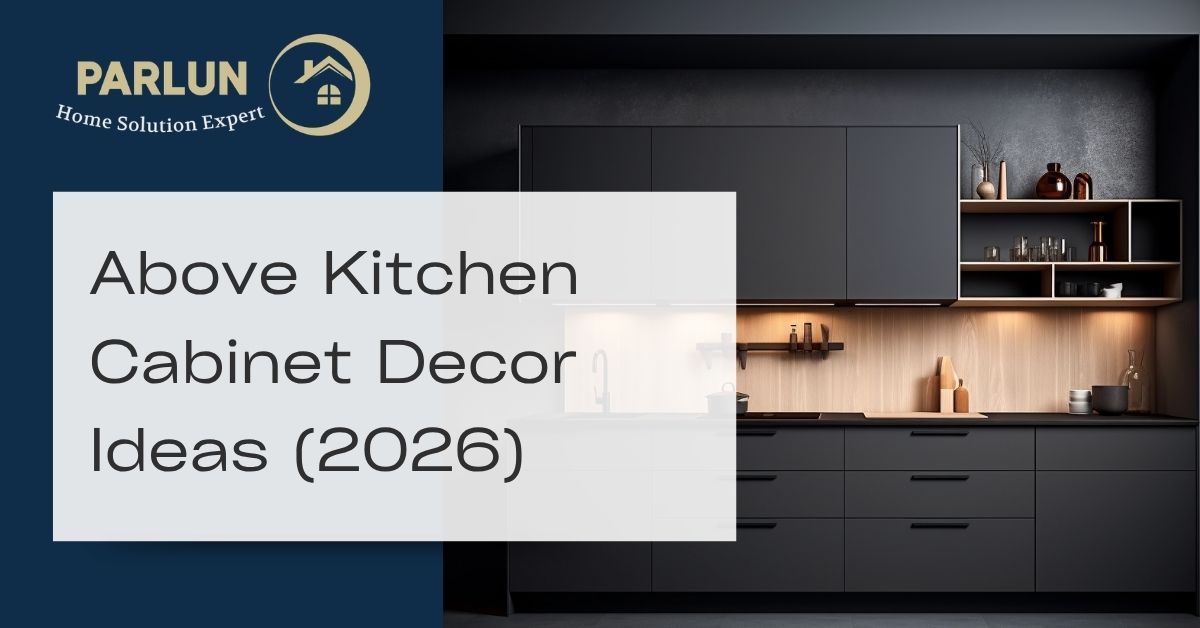
Modern above cabinet decor lives or dies by restraint. Where a farmhouse kitchen can carry a full, layered display, a modern kitchen wants the opposite. The clean lines of modern kitchen cabinets and quartz counters look best with empty space around a few strong pieces.
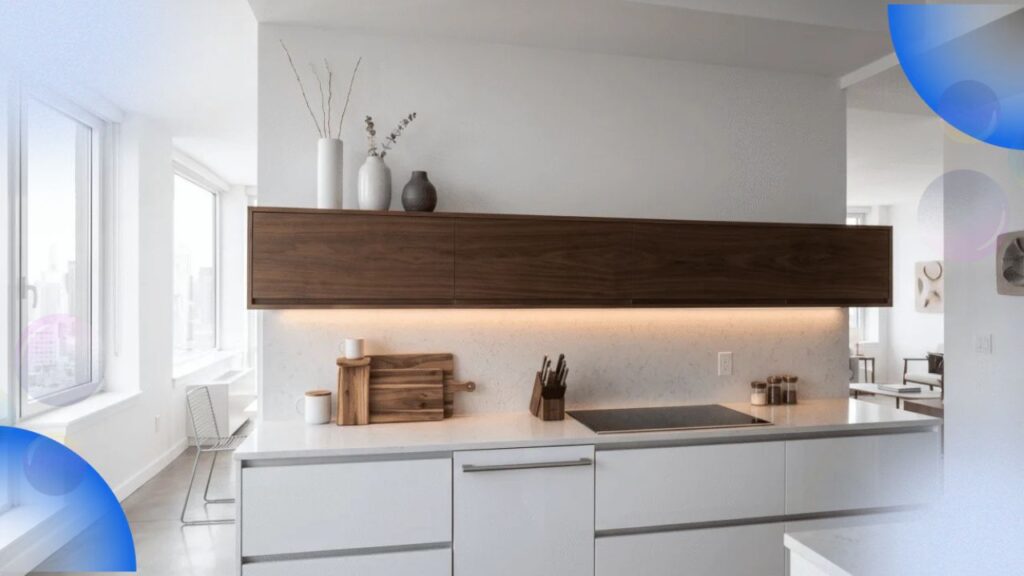
Treat negative space as a design choice rather than a gap you are forced to fill. Two or three large objects with room to breathe do far more than a dozen small ones crammed together. Repeat a simple shape, such as three tall vessels of different heights, so the eye moves easily across the top.
Keep the palette almost monochrome. Blacks, warm whites, natural wood, and one muted accent suit modern schemes, and matte finishes usually beat shiny ones. If you are unsure whether a piece belongs, leave it out. One strong silhouette beats a crowded ledge every time.
Cleaning Safety and Maintenance for Cabinet Top Decor
Dust and cooking grease can build up on cabinet tops, especially near the stove.
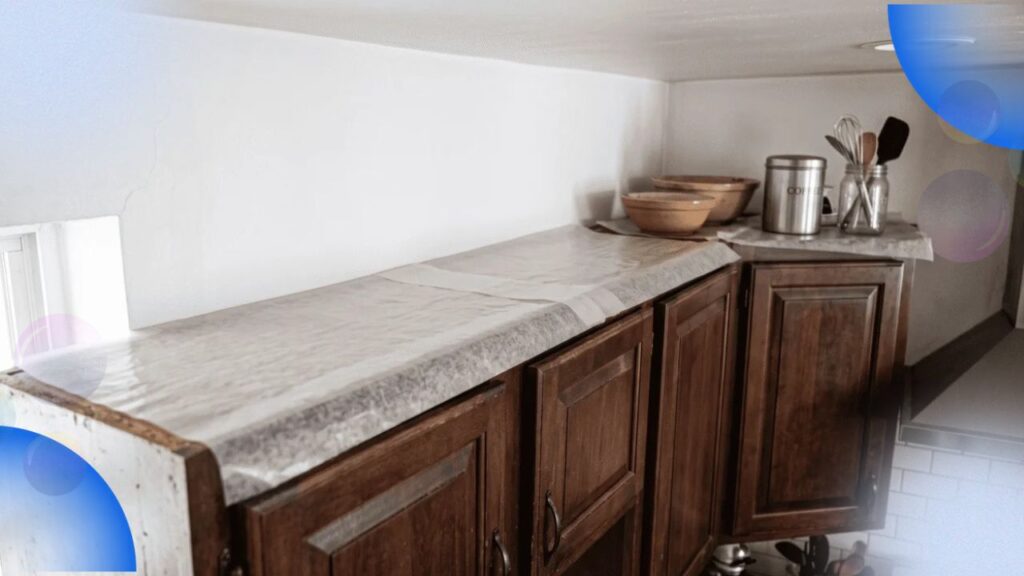
The easiest fix is to line the cabinet tops with wax paper or foil before you place anything. When it gets grimy, roll it up and lay down a fresh sheet instead of scrubbing. Dust the display about once a month, and more often if your kitchen has weak ventilation or the decor sits near the stove.
Choose objects you can wipe down. Glazed ceramics, metal, and sealed baskets clean up easily, while raw paper and fabric trap grease. Keep fragile pieces somewhere safer, and in earthquake prone areas secure taller items with museum putty.
Cleaning and safety checklist
How Custom Cabinets Remove the Awkward Gap
Sometimes the best above cabinet decor is no gap at all. If the empty strip has always bugged you, a few permanent options remove it completely and add real value.
Full height custom cabinets extend storage to the ceiling and make the room feel taller. Crown molding bridges a smaller gap with a clean architectural finish. Glass-front display cabinets or small stacked cabinets provide enclosed storage and help protect the contents from dust and cooking grease.
These upgrades work best planned as part of the cabinetry rather than added later. That is where a custom maker helps. Parlun designs custom kitchen cabinets to fit your exact ceiling height, so you can choose full height storage, integrated molding, or a display row instead of an awkward gap.
Want to close the gap for good? Book a free design consultation with Parlun or request a catalog to see full height cabinet options for your kitchen.