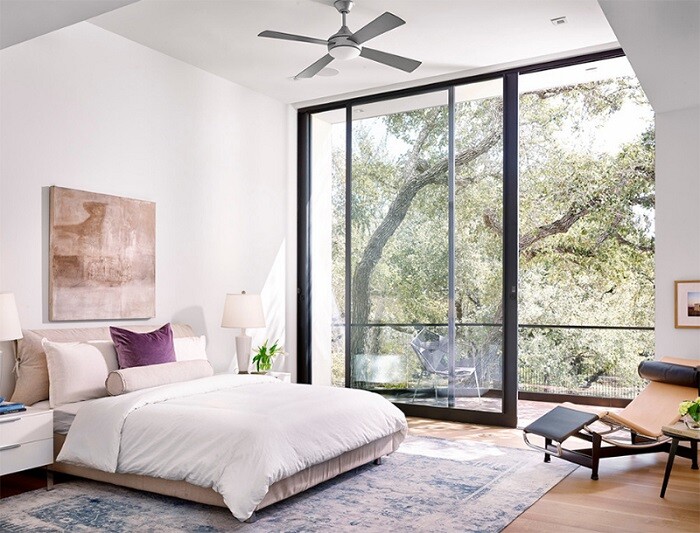
Mid-century homes with floor-to-ceiling A-frame windows are breathtaking. Natural light floods the interior. Architectural lines create dramatic angles. Glass walls blur the boundary between indoors and outdoors.
But here’s the challenge: designing a kitchen that works with this architecture not against it.
The kitchen is the most visually exposed and structurally affected space in an A-frame home. Sloped ceilings, massive daylight, and open-plan layouts demand intentional design choices. In this guide, we’ll explore how to create a kitchen that maintains architectural harmony while embracing modern function
Not every modern kitchen belongs in a mid-century shell. The structure should always win.
The mistake many homeowners make is treating these kitchens like standard open-concept spaces. They’re not. The angles change everything—sloped ceilings, exposed beams, and full-height glass demand a completely different design strategy.
Understanding Mid-Century A-Frame Architecture
To design well, you must understand what you’re preserving.
Mid-century modern architecture is rooted in clean geometry, minimal ornamentation, and a strong connection to nature. In A-frame home design, the steep triangular roofline extends downward, often framed by dramatic floor-to-ceiling glass walls.
Key characteristics include:
- Open-plan mid-century interiors
- Exposed beams and pronounced ceiling angles
- Seamless indoor-outdoor living spaces
- Minimal decorative detailing
- Natural materials like wood and stone
Because of this structural clarity, kitchens cannot feel visually heavy. Every material, cabinet line, and lighting decision must support the architectural rhythm.
When done correctly, the kitchen becomes part of the framework — not an interruption within it.
How Floor-to-Ceiling A-Frame Windows Influence Kitchen Design
Kitchens with floor-to-ceiling windows don’t behave like standard kitchens. In mid-century homes with dramatic A-frame architecture, light isn’t just a feature — it’s a structural force that shapes every design decision.
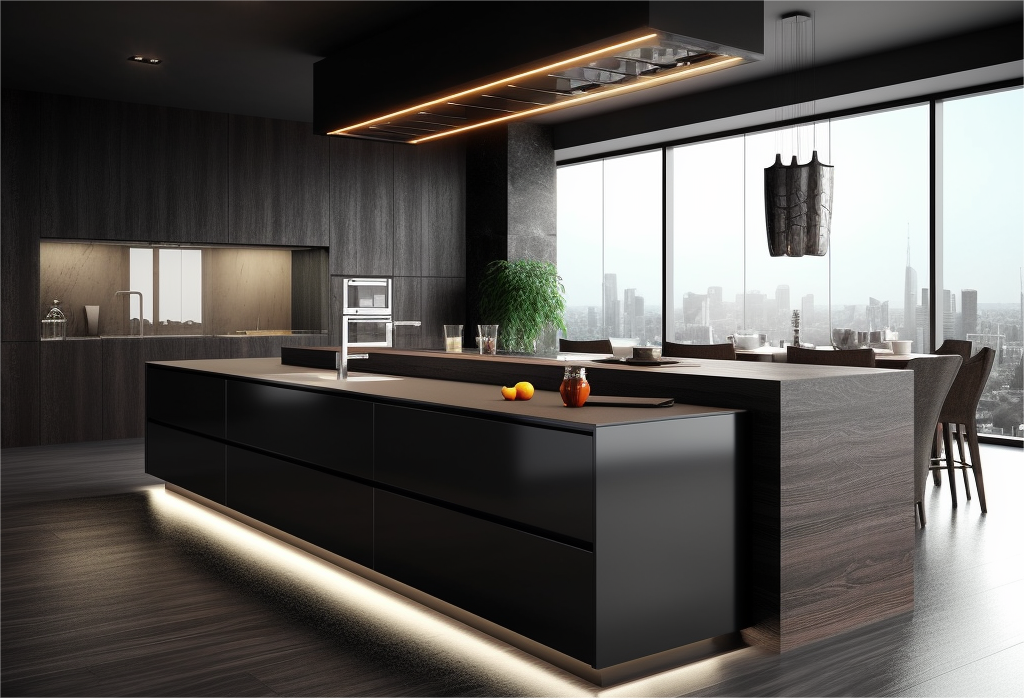
At first glance, more natural light feels like a luxury. And it is. But this is where many renovations go wrong.
Homeowners often treat these kitchens like typical open-plan spaces. They install glossy cabinetry, polished quartz, or high-shine backsplashes — assuming the brightness will enhance them.
By mid-afternoon, especially in west- or south-facing homes, those same surfaces can become mirror-like. The result? Harsh glare, eye strain, and a kitchen that feels visually loud rather than calm.
In glass-wall homes, reflection is not a minor detail. It changes how the entire space feels throughout the day.
That’s why glare-free kitchen materials matter more here than in almost any other layout. Matte kitchen finishes, textured stone countertops, and warm wood kitchen finishes diffuse light instead of bouncing it back. They soften intensity while preserving the openness that defines mid-century modern architecture.
Heat and UV Exposure
There’s another layer most people don’t anticipate: prolonged sun exposure.
In kitchens with floor-to-ceiling windows, cabinetry and flooring can fade unevenly over time if materials aren’t chosen carefully. This is especially relevant in modern mid-century renovation projects where preserving warmth and tone consistency is critical.
In 2026, sustainable kitchen materials with UV-resistant finishes are no longer just eco-conscious choices — they’re practical ones. Low-VOC sealants, engineered wood cores, and stone surfaces that tolerate heat shifts help maintain long-term durability in daylight-focused interiors.
Constant Visual Exposure
Full-height glass also means your kitchen is always visible — from the living area, from the dining space, and often from the exterior.
In open-plan mid-century interiors, there’s nowhere to visually “hide” heavy cabinetry or clutter. Bulky upper cabinets can disrupt architectural harmony. Dark, oversized elements can compete with the structural lines of the A-frame.
That’s why kitchen design for glass-wall homes must prioritize visual lightness. Slim profiles, minimalist kitchen cabinetry, and intentional negative space preserve the connection between indoors and outdoors — one of the defining principles of mid-century modern kitchen design.
In these homes, the kitchen isn’t just a workspace. It’s part of the architecture. And it has to respond to it.
Best Kitchen Layouts for Mid-Century A-Frame Homes
When planning mid-century kitchen layouts, simplicity isn’t a stylistic choice — it’s a structural necessity.
Sometimes, less really is more. Let the architecture lead, and the kitchen will follow.
In A-frame home design, the architecture already makes a bold statement. The triangular roofline, exposed beams, and vertical glass walls dominate the space. A complicated kitchen layout doesn’t enhance that drama — it competes with it.
The key is to let the structure lead.
Open Kitchen Layout (But Done Intentionally)
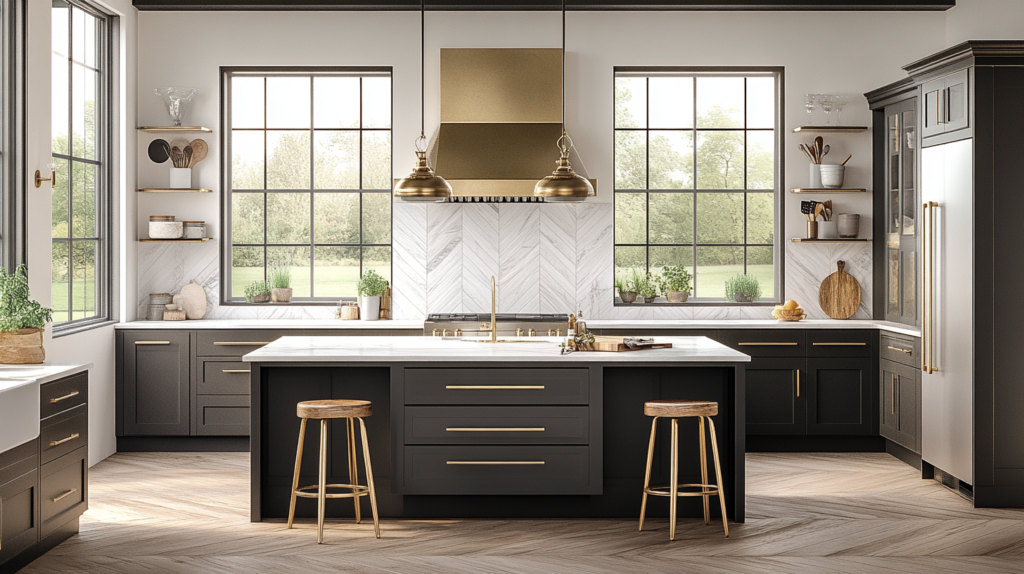
An open-concept kitchen design naturally complements open-plan mid-century interiors. However, simply “removing walls” isn’t enough.
The real mistake happens when upper cabinets are installed along window walls, visually cutting into the height that makes A-frame homes special. In kitchens with floor-to-ceiling windows, preserving vertical openness is critical.
Instead:
- Keep window-facing walls free of bulky cabinetry
- Use lower-profile base cabinets
- Allow the ceiling angles to remain visible
When done correctly, the kitchen feels integrated into the architecture — not inserted into it.
Single-Wall Kitchens (Often the Smartest Choice)
Many A-frame homes have narrower footprints than they appear from the outside. The angled walls reduce usable vertical space.
This is where a single-wall kitchen becomes powerful.
By consolidating cabinetry along one structural wall, you:
- Respect the sloped ceiling lines
- Preserve openness in the central space
- Maintain visual flow toward glass walls
In mid-century modern kitchen design, restraint often creates stronger impact than symmetry.
For compact A-frame home kitchen ideas, this layout keeps the design intentional rather than forced.
Island-Focused Layouts (Placement Matters More Than Size)
Kitchen island placement in glass-wall homes requires precision.
A poorly positioned island can interrupt sightlines to the outdoors — the very feature that defines mid-century homes with expansive glazing.
Before finalizing placement, ask:
- Does the island block the view from the window when seated?
- Does it compete with the A-frame’s central axis?
- Does it feel heavy under the sloped ceiling?
Floating islands with slim bases, open shelving ends, or softened corners work best in a natural light kitchen design. They anchor the kitchen without visually weighing it down.
In many modern mid-century renovations, the island becomes the transition point between cooking and living areas — reinforcing the home’s open flow.
Because A-frame homes exaggerate height, oversized cabinetry or double islands can feel disproportionate very quickly.
In kitchens with floor-to-ceiling windows, scale must respond to structure. Clean horizontal lines grounded beneath dramatic vertical glass create balance — and that balance is what makes these homes feel architectural rather than cluttered.
The most successful layouts don’t just “fit” the space.
They respond to it.
Cabinet Styles That Work Best in Mid-Century Homes
In mid-century homes with floor-to-ceiling A-frame windows, cabinetry isn’t just storage — it becomes part of the architectural composition.
Because these kitchens sit beneath dramatic rooflines and expansive glass, cabinets must feel intentional, restrained, and visually balanced. The wrong door style can disrupt the entire structure.
The most common mistake? Treating cabinetry as a decorative feature instead of an architectural one.
In A-frame spaces flooded with natural light, ornate detailing, raised panels, or heavy molding start to compete with exposed beams and strong ceiling angles. The result feels cluttered — even if the layout is technically minimal.
Flat-Panel Cabinetry: The Architectural Choice
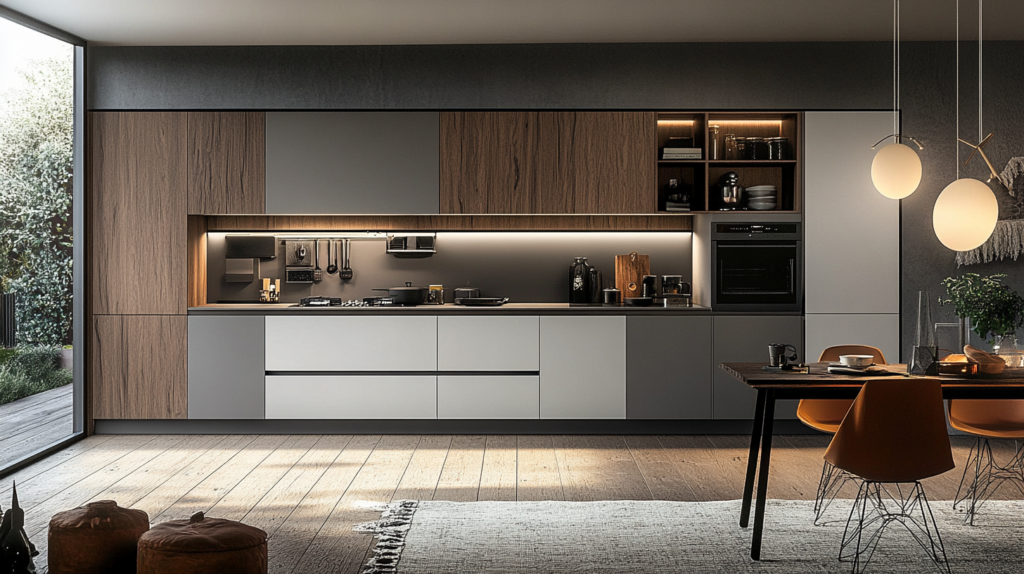
Flat-panel cabinetry aligns naturally with mid-century modern kitchen design because it mirrors the clean structural lines of the home itself.
No visual noise.
No unnecessary shadow lines.
Just uninterrupted surfaces that allow light to move softly across them.
In kitchens with floor-to-ceiling windows, this simplicity prevents reflection chaos and maintains calm.
Minimalist Kitchen Cabinetry (Less Hardware, More Harmony)
Integrated handles or slim linear hardware preserve visual flow.
In daylight-focused interiors, bulky handles create unnecessary contrast and shadow. Subtle hardware keeps the cabinetry feeling built-in rather than layered on.
This is especially important in kitchen design for glass-wall homes where everything is constantly visible from multiple angles.
Warm Wood Kitchen Finishes: Why They Work So Well
Mid-century modern kitchen cabinets traditionally feature walnut, oak, or teak tones — and there’s a reason these materials continue trending in 2026.
Warm wood kitchen finishes:
- Soften intense natural light
- Counterbalance glass and steel elements
- Reinforce indoor-outdoor living spaces
- Age gracefully under sunlight
Cool-toned laminates or stark white gloss can feel sterile in A-frame homes. Wood introduces warmth without overpowering the architecture.
In modern mid-century renovation projects, designers often choose matte-stained oak or lightly textured walnut veneers to prevent glare while preserving grain depth.
What to Avoid (And Why)
High-gloss acrylics might look striking in a showroom.
But in kitchens with large glass walls, they can become overly reflective and visually sharp.
Similarly, traditional raised-panel doors or decorative molding interrupt the minimalist rhythm that defines mid-century homes.
The goal isn’t trend-driven cabinetry.
It’s visual calm that supports architectural harmony.
Maintaining Material Continuity
To strengthen cohesion, align cabinetry choices with other interior elements — beams, flooring, or even exterior wood accents.
For deeper exploration, reviewing modern kitchen cabinet designs and wood kitchen cabinets can help maintain continuity across finishes and reinforce a unified aesthetic.
In mid-century A-frame homes, the best cabinets don’t demand attention.
They support the architecture — quietly, confidently, and intentionally.
Choosing Materials That Balance Light and Warmth
In kitchens with floor-to-ceiling windows, material selection isn’t just about style — it directly affects comfort.
What looks beautiful in the morning can feel overwhelming by afternoon.
Many homeowners assume brighter is better. They choose polished quartz, glossy cabinetry, and reflective backsplashes to amplify daylight. But in mid-century homes with dramatic A-frame glass walls, that approach can backfire.
Too much shine under intense sun creates visual fatigue. The kitchen starts to feel sharp instead of serene.
The solution isn’t reducing light — it’s diffusing it.
Matte Over Gloss: A Practical Decision
Matte kitchen finishes absorb and soften daylight instead of bouncing it aggressively across the room.
In natural light kitchen design, matte surfaces:
- Reduce glare near glass walls
- Prevent reflection hotspots on countertops
- Maintain a calm, grounded atmosphere
This is especially important in open-plan mid-century interiors where the kitchen flows directly into living areas. Visual harshness doesn’t stay contained — it spreads.
Natural Stone Countertops That Ground the Space
Highly polished surfaces may look dramatic in artificial lighting, but in kitchens with floor-to-ceiling windows, subtle texture wins.
Honed quartzite, leathered granite, and matte quartz provide durability without excessive reflection. Natural stone countertops with soft finishes create depth rather than shine.
In many modern mid-century renovation projects, designers intentionally choose stone with gentle movement — not busy veining — to avoid competing with strong architectural lines.
The goal is balance, not spectacle.
Wood + Stone: The Warmth Equation
A-frame homes are dominated by glass and geometry. Without warmth, they can feel almost gallery-like.
Pairing warm wood kitchen finishes with textured stone restores equilibrium.
Wood absorbs light.
Stone anchors it.
Together, they create architectural harmony — reinforcing the connection between indoor and outdoor living spaces that defines mid-century modern kitchen design.
This material pairing strongly aligns with 2026 organic modern kitchens, where natural elements are used not as decoration, but as foundational design language.
Lighting Design for Kitchens with A-Frame Windows
Daylight isn’t enough.
In fact, the larger the glass walls, the more dramatic the contrast becomes after sunset.
When evening falls, expansive windows turn into dark voids. Without thoughtful lighting, kitchens in A-frame homes can feel unexpectedly shadowed — especially under steep ceiling angles.
This is where layered kitchen lighting becomes essential.
Why One Light Source Fails
Relying solely on recessed ceiling fixtures often creates uneven brightness. Sloped ceilings cast angled shadows. Upper beams block light distribution.
The result? Dark prep areas and flat ambiance.
Instead, successful kitchen design for glass-wall homes includes multiple layers:
- Ambient kitchen lighting to establish overall brightness
- Pendant lights for kitchen islands to create visual anchors
- Task lighting in kitchens beneath cabinets for functionality
- Accent lighting along beams to highlight architectural features
Layering prevents shadow pockets and maintains depth after dark.
In daylight-focused interiors, lighting isn’t just functional it’s atmospheric. It ensures that the kitchen feels as inviting at night as it does under afternoon sun.
And in mid-century homes with floor-to-ceiling A-frame windows, that transition from light to evening glow is where thoughtful design truly reveals itself.
Common Kitchen Design Mistakes in Mid-Century A-Frame Homes
Mid-century A-frame renovations often fail for one simple reason: the kitchen is designed as a standalone room instead of an architectural response.
In homes defined by steep rooflines and floor-to-ceiling glass, small design missteps become amplified. Light exaggerates them. Angles expose them.
Here are the mistakes that most commonly disrupt architectural harmony.
High-Gloss Cabinets
Glossy finishes may look sleek in a showroom, but in kitchens with expansive glass walls, they can become aggressively reflective.
By mid-afternoon, especially in sun-facing homes, gloss cabinetry can create visual glare that competes with the natural environment outside. Instead of enhancing natural light kitchen design, it fights it.
Matte and lightly textured finishes almost always perform better in these settings.
Overly Dark Color Palettes
Dark charcoal or flat black kitchens may feel dramatic in urban spaces. But in mid-century homes with A-frame architecture, they can absorb the very light that defines the structure.
The result? A space that feels visually compressed rather than open.
Warm neutrals, natural wood tones, and muted earthy palettes preserve openness while maintaining sophistication.
Ignoring Ceiling Angles
Standard-height cabinets installed under steep rooflines often look awkward and disconnected.
In A-frame home kitchen ideas, proportion matters more than symmetry. Custom heights, stepped cabinetry, or negative space above cabinets can maintain flow while respecting structural geometry.
When cabinetry ignores the roofline, the tension is immediate — and not in a good way.
Blocking Window Walls
One of the most damaging mistakes in kitchen design for glass-wall homes is placing tall cabinetry against full-height windows.
It interrupts sightlines.
It breaks indoor-outdoor continuity.
It weakens the architectural impact.
In mid-century modern kitchen design, glass is not an empty wall — it’s the defining feature.
Smart kitchen remodeling tips prioritize openness, scale, and structural respect above decorative layering.
2026 Kitchen Trends That Complement Mid-Century Architecture
Design trends evolve. Architecture doesn’t.
The key in 2026 isn’t chasing what’s new — it’s choosing trends that naturally reinforce mid-century principles.
Organic Modern Kitchens
Soft textures, subtle curves, and nature-forward materials are dominating current renovations. This trend blends beautifully with mid-century homes because both emphasize simplicity and connection to nature.
Organic modern kitchens feel warm without being rustic. Minimal without being cold.
Japandi + Mid-Century Fusion
The fusion of Japanese minimalism and Scandinavian warmth aligns naturally with A-frame homes.
Clean lines. Muted tones. Thoughtful restraint.
In daylight-focused interiors, this style enhances architectural clarity rather than distracting from it.
Sustainable Kitchen Design
Sustainability is no longer optional — it’s expected.
Recycled wood cabinetry, low-VOC finishes, energy-efficient lighting, and responsibly sourced stone materials all support long-term durability in kitchens with floor-to-ceiling windows.
In mid century modern modular homes, especially, sustainable materials align with both aesthetic and construction efficiency.
Seamless Indoor-Outdoor Kitchens
One of the strongest 2026 shifts is continuity.
Extending flooring materials, wood finishes, or stone textures from kitchen interiors to adjacent patios reinforces architectural flow — a core principle of open-plan mid-century interiors.
This approach strengthens indoor-outdoor living spaces, which are central to the appeal of mid-century homes.
Renovation Strategy: How to Modernize Without Losing Character
Modernizing a mid-century home isn’t about replacing the past.
It’s about refining it.
In successful modern mid-century renovation projects, designers focus on:
- Preserving exposed structural beams
- Restoring original wood elements where possible
- Updating kitchen layouts without altering architectural rhythm
- Choosing minimalist kitchen layouts that respect spatial openness
The structure should always lead the renovation, not trend pressure.
When the architecture remains the focal point, the kitchen naturally feels integrated rather than imposed.
FAQs
What is a mid-century modern home?
A mid-century modern home is a residential architectural style that gained popularity between the 1940s and 1970s. It emphasizes clean horizontal lines, open layouts, integration with nature, and expansive glass. A-frame variations heighten vertical drama and maximize natural light.
How to renovate a mid-century modern home?
The most successful renovations preserve architectural identity first. Focus on updating kitchens and bathrooms with minimalist finishes, sustainable kitchen materials, and layouts that maintain openness. Avoid ornate detailing or heavy traditional elements that disrupt structural simplicity.
Are mid century modern homes in Sydney, Australia, popular?
Yes. Mid century modern homes in Sydney Australia, have seen renewed interest due to their strong architectural presence and compatibility with indoor-outdoor living — especially in coastal and light-rich environments.
What are mid century modern modular homes?
Mid century modern modular homes combine prefabricated efficiency with mid-century aesthetics. Clean lines, flat planes, and natural material palettes make them cost-effective while maintaining architectural clarity.
.