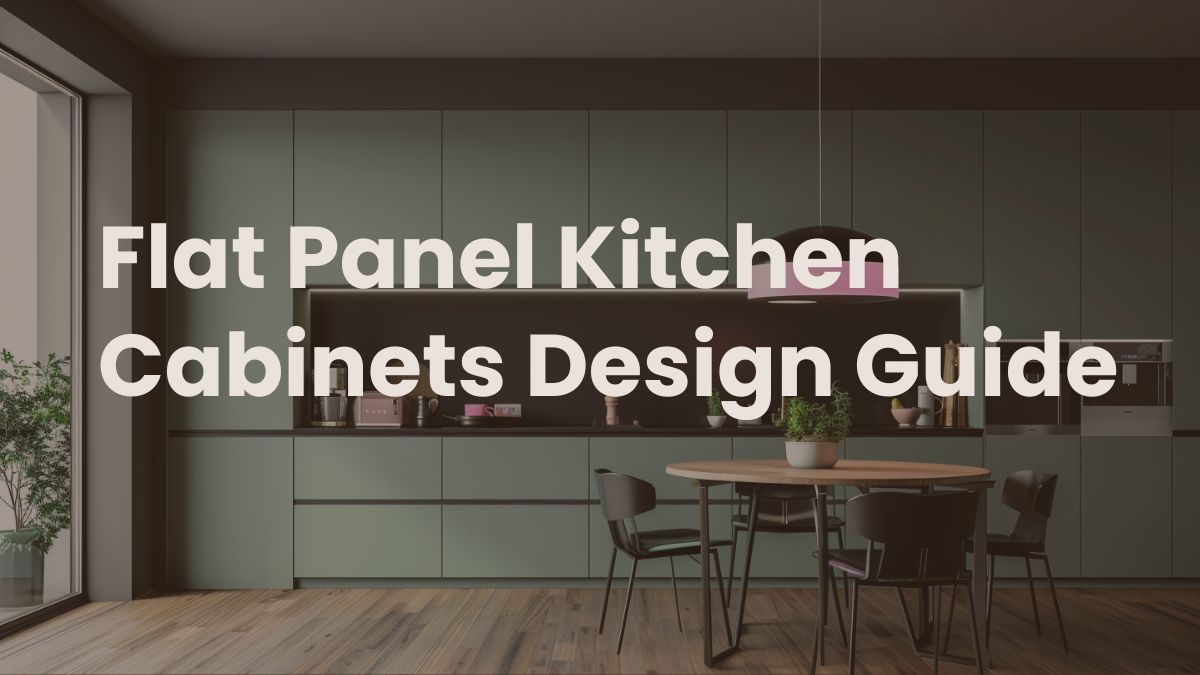
Flat panel cabinets put the focus on colour, material and proportion rather than decorative door detail. There is no routed frame, no moulding and nothing applied to the face of the door. What you see is a single flat surface, and that simplicity is both the appeal and the design challenge. Getting flat panel cabinets right demands more careful attention to finish quality, material choice and hardware than other door styles, because nothing else in the design will draw the eye if something is off. This guide covers everything from material selection to handleless options, cost and the practical question of who this style actually suits.
Quick Summary of Flat Panel Cabinets
Flat panel cabinets, also called slab doors, suit any kitchen where clean lines and an uncluttered surface are the priority.
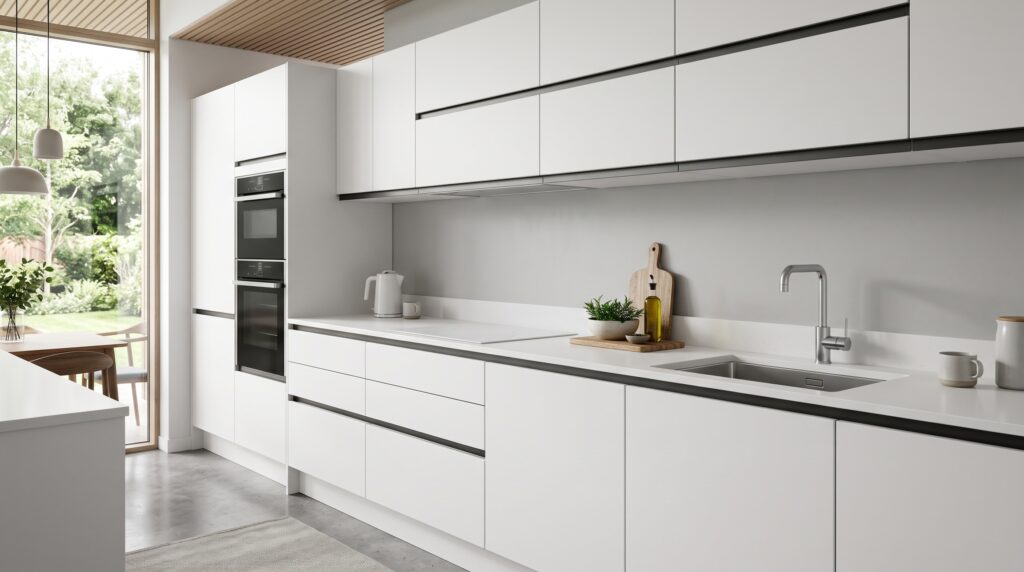
They are the standard door in modern and contemporary kitchen design and pair well with painted MDF, wood veneer, laminate and acrylic finishes. Compared with shaker cabinets, flat panel doors have no routed frame, making them easier to clean and more streamlined in appearance. The trade-off is that the flat surface shows fingerprints, misalignment and any finish imperfection more readily than a profiled door.
Handleless configurations using a gola channel, J pull or push to open mechanism are the most popular approach in contemporary kitchens and maximise the visual simplicity. Bar pulls and edge pulls work equally well for those who want a defined grip. Flat panel cabinets span from budget laminate to premium veneer and solid timber, and cost varies significantly by material and finish.
What Flat Panel Cabinets Are
A flat panel cabinet, sometimes called a slab door or flat front cabinet, is a door made from a single flat surface with no frame, profile or raised section applied. The front of the door is a plain board or panel, and nothing else. That construction is what separates flat panel from every other door style on the market.
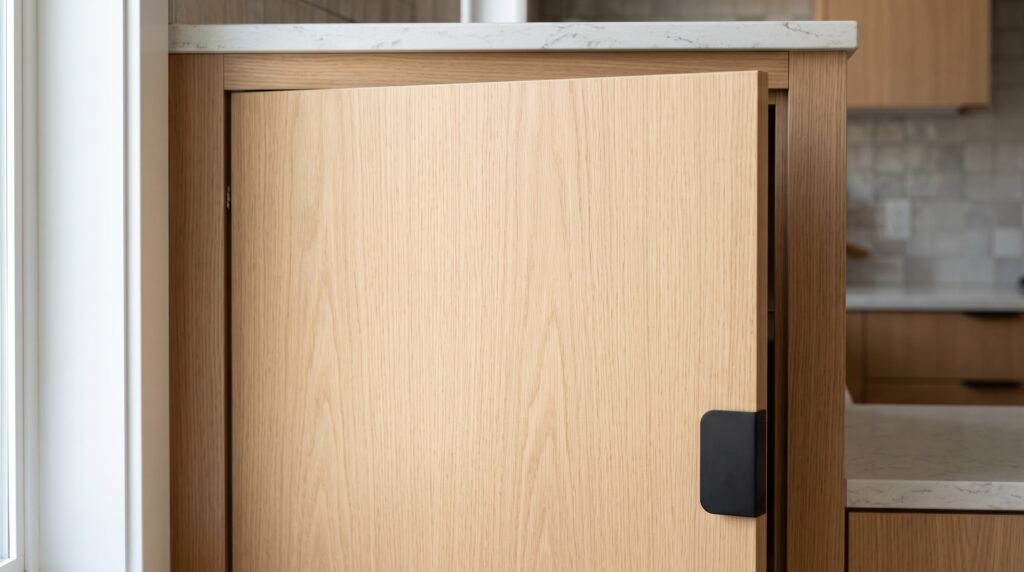
In practical terms, flat panel doors are almost always used with a frameless cabinet box rather than a face-framed one. A frameless cabinet, also called a European-style box, has no structural frame across the front opening. The door covers the full front of the box in a full-overlay configuration, which means less visible gap between doors and a cleaner, more continuous surface across the kitchen run. For a full comparison of frameless and face-framed cabinet boxes, see the framed vs frameless cabinets guide.
The flat panel door itself can be made from many different materials. The door style describes the profile; the material describes what the door is made from. The two decisions are separate and should be treated that way.
Flat Panel Compared with Shaker and Raised Panel Cabinets
The three most common cabinet door profiles are flat panel, shaker and raised panel. Understanding how they differ helps in choosing the right option for a specific kitchen style and maintenance preference.
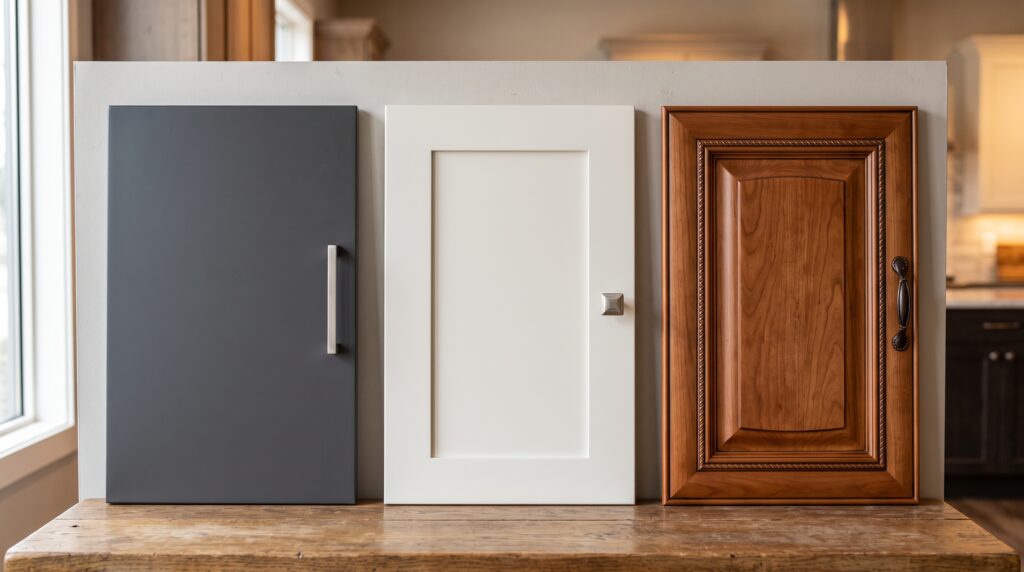
Shaker doors have a flat centre panel surrounded by a routed or assembled frame, typically with rails across the top and bottom and stiles running vertically on each side. This simple profile suits a wide style range, from farmhouse through to modern transitional. The corner joints where rails and stiles meet collect dust and grease and require more attention when cleaning. Shaker kitchen cabinets remain the most popular door profile in UK and North American kitchens.
Raised panel doors have a central section that sits proud of the surrounding frame, requiring more complex moulding and assembly. They are associated with traditional and period kitchens and are the most involved to clean of the three profiles.
Flat panel sits at the opposite end of the complexity range. It cleans most easily, suits contemporary interiors most naturally and is the most exposed to installation quality, since every alignment gap and surface imperfection is immediately visible against the smooth, unbroken face.
|
Aspect |
Flat Panel |
Shaker |
Raised Panel |
|---|---|---|---|
|
Appearance |
Smooth, uninterrupted surface |
Simple recessed frame |
Central raised section |
|
Style range |
Modern, contemporary |
Transitional to farmhouse |
Traditional, classic |
|
Cleaning |
Easiest: no grooves or joints |
Moderate: frame corners collect dust |
Most involved: multiple angles |
|
Cost range |
Low to high |
Generally mid-range |
Mid to high |
|
Construction |
Single board or skin |
Assembled frame and panel |
Complex moulding |
|
Best home style |
Contemporary, open-plan |
Most home styles |
Period, traditional |
Materials and Finishes for Flat Panel Doors
The door profile is only part of the decision. The material determines surface quality, durability, edge finish and price.
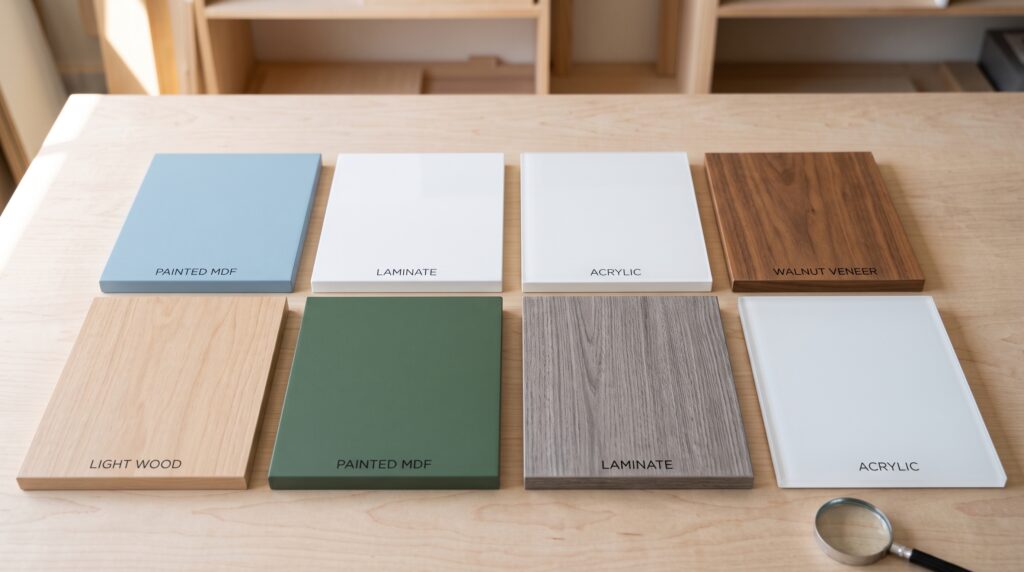
Painted MDF
MDF (medium-density fibreboard) is the most common material for painted flat panel doors. Its fine, consistent surface takes paint smoothly and allows the sharpest colour accuracy of any cabinet substrate. It is dimensionally stable, meaning it does not expand or contract significantly with humidity changes. The edge must be primed and painted carefully, as MDF edges absorb moisture if left unsealed.
Laminate
Laminate flat panel doors use a decorative surface bonded to a board core, typically MDF or particleboard. They are highly durable, resistant to scratching and available in a very wide range of colours and patterns including wood-look and stone-look options. Laminate is the most cost-effective material for flat panel production at scale.
Acrylic High Gloss
Acrylic flat panel doors produce a very high-gloss, reflective surface. This finish is striking but shows fingerprints, smears and fine scratches more than any other option. It suits bold, contemporary kitchens where the trade-off in maintenance is accepted as part of the look.
Wood Veneer
Wood veneer flat panel doors use a thin slice of real timber bonded to a stable engineered core. They offer the natural grain and warmth of solid wood with better dimensional stability. Edge quality and veneer thickness both matter significantly for longevity. A reputable supplier should specify the veneer thickness and edge treatment before production.
Solid Wood
Solid wood flat panel doors have natural character and visible grain throughout the full thickness. They are the heaviest and most premium option but more susceptible to movement with humidity than engineered alternatives. The edge detail is naturally integrated.
Glass and Metal Look
Glass-insert flat panel doors replace the solid panel with a full sheet of glass, typically used in upper cabinets for display. Metal-look laminates replicate the appearance of brushed steel or aluminium without the weight or cost.
|
Material |
Surface |
Durability |
Style Direction |
Care |
|---|---|---|---|---|
|
Painted MDF |
Smooth matte or satin |
Good |
Contemporary, any colour |
Wipe clean; touch up chips |
|
Laminate |
Wide pattern range |
Very good |
Modern, budget conscious |
Wipe clean |
|
Acrylic high gloss |
Reflective, mirror-like |
Good |
Bold contemporary |
Shows fingerprints; soft cloth only |
|
Wood veneer |
Natural grain |
Good |
Warm modern, transitional |
Oil or lacquer as specified |
|
Solid wood |
Grain and character |
Excellent |
Premium natural kitchens |
Oil periodically |
|
Glass insert |
Transparent or frosted |
Moderate |
Display upper cabinets |
Clean glass regularly |
Hardware and Handleless Options
The hardware choice is more visible on a flat panel cabinet than on any other door style, because there is no other design detail to draw the eye. Every handle or pull becomes a deliberate decision.
Note: While J-Pull cuts directly into the door panel, a true Gola system anchors the aluminum channel into the cabinet box itself, allowing the slab door to remain entirely flat.
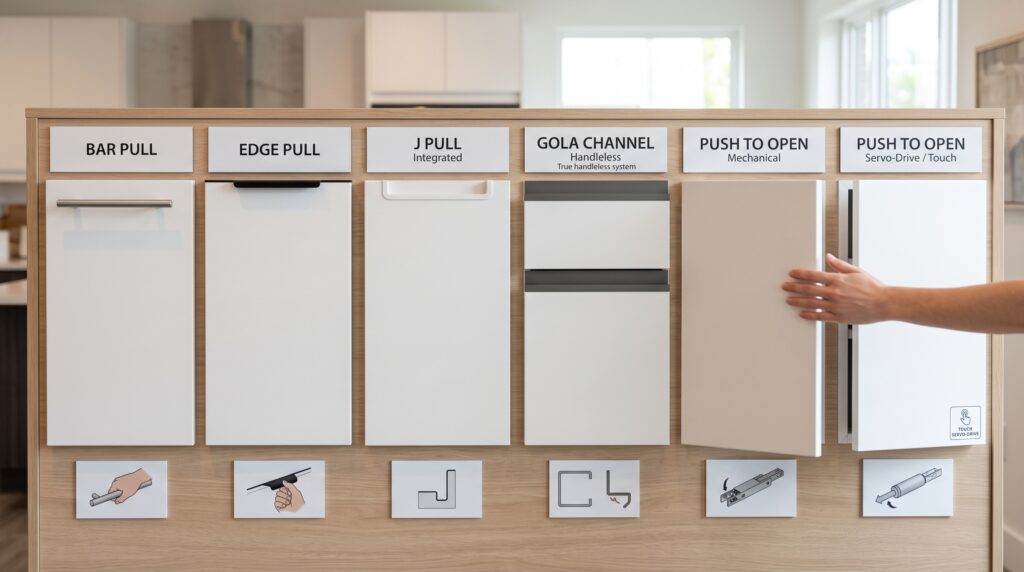
The most popular configurations in contemporary flat panel kitchens are handleless. A handleless cabinet does not mean no way to open the door; it means the opening mechanism is integrated into the design rather than mounted on the door surface.
A gola channel is an aluminium profile that runs the full width of the cabinet door run, typically at the top or bottom edge. Gripping the channel opens the door. This provides the cleanest, most integrated look and is widely used in premium modern kitchens. A J pull is a channel routed directly into the top or bottom edge of the door. It is less visible than a gola and provides less grip, but suits lighter doors and drawers well. Push to open uses a spring-loaded touch-latch inside the cabinet, which suits upper cabinets and lighter drawers best.
Bar pulls and edge pulls are conventional hardware options that both work well on flat panel doors when a defined grip point is preferred. For a full discussion of handleless kitchen options, see the handleless kitchen cabinets guide.
|
Option |
Description |
Visual Effect |
Best For |
|---|---|---|---|
|
Gola channel |
Continuous aluminium rail across door run |
Fully integrated |
Premium contemporary kitchens |
|
J pull |
Routed channel at door top or bottom edge |
Nearly invisible |
Clean look with moderate grip |
|
Push to open |
Touch-latch behind door face |
Handle-free |
Upper cabinets and lighter drawers |
|
Bar pull |
Bar mounted on door face |
Clearly visible |
All door weights; reliable grip |
|
Edge pull |
Recessed notch at door edge |
Minimal |
Light-use lower cabinets |
Flat Panel Cabinet Pros and Cons
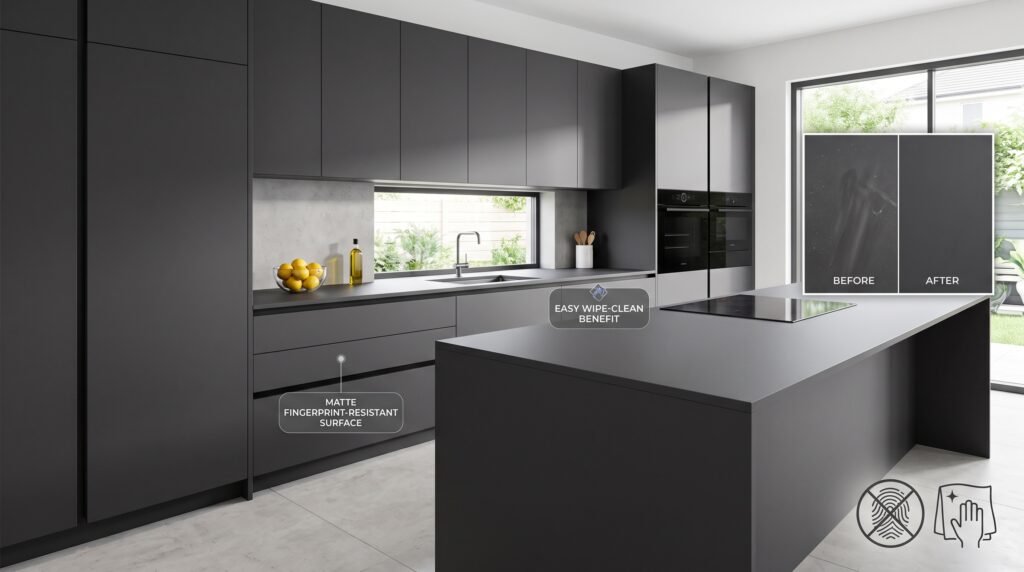
Advantages:
Disadvantages:
The flat surface that makes flat panel cabinets the easiest to clean is the same surface that makes imperfections easier to see. That is the central trade-off of the style.
Flat Panel Cabinet Cost and Quality Factors
The price range for flat panel kitchen cabinets is wider than for almost any other door style. A budget laminate flat panel door is among the least expensive cabinet options available; a solid timber or premium acrylic equivalent can cost many times more. The material is the primary cost driver.
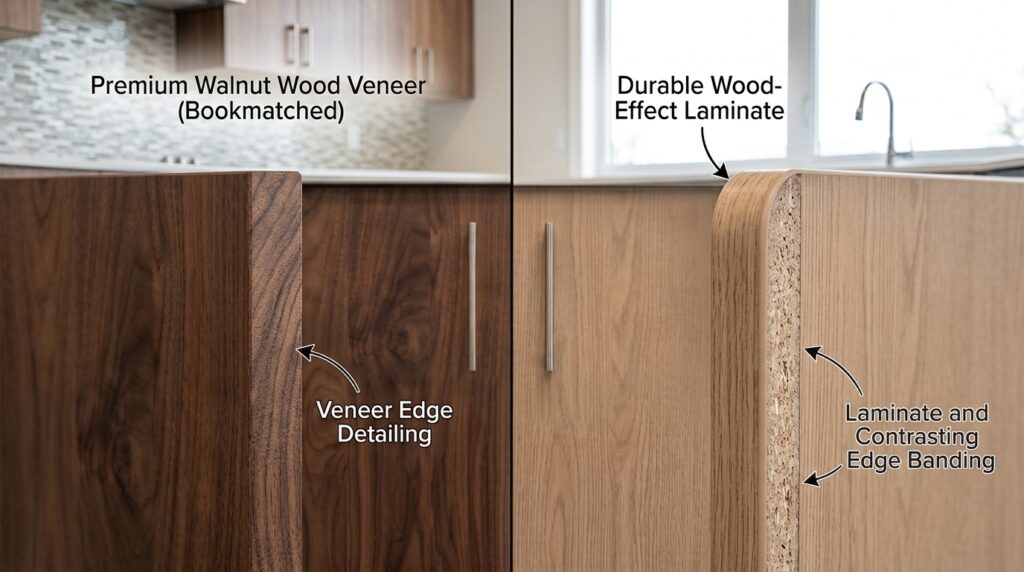
Beyond material, the main quality factors are edge banding, construction and finish consistency. Edge banding is the strip of material applied to the door perimeter. A thick, well-bonded edge holds up to daily use and resists moisture. A thin or poorly bonded edge lifts, separates and becomes the most visible sign of a lower-quality door.
Cabinet box construction, hinge quality and drawer mechanism all affect the overall price of the finished kitchen. Premium flat panel doors do not make a premium kitchen if the cabinet boxes, hinges and fittings behind them are low quality.
Custom sizing, painted-to-order colours, matched veneer and specialist finishes all add cost. They also add longevity and visual coherence to the final installation, particularly in larger or open-plan kitchens where the cabinet run is more exposed.
Who Should Choose Flat Panel Cabinets
Flat panel cabinets suit buyers who want a clean, contemporary kitchen without decorative door profile. They are particularly strong in open-plan spaces where the kitchen is visible from multiple angles, because the uncluttered surface holds its visual calm at a distance and in natural light.
Buyers who value low-maintenance cleaning, dislike the look of a traditional or farmhouse kitchen and want the broadest possible finish and colour range will find flat panel the most flexible option. They are a less instinctive choice for buyers who want warmth, texture or visible craft detail, or for those designing a period or traditional interior.
Decision Checklist
Order Flat Panel Cabinet Doors Factory-Direct from Parlun
Parlun Building manufactures flat panel kitchen cabinet doors factory-direct, available in painted warm neutrals, accent colours, wood veneers and laminate finishes. Both standard and custom door sizes are produced to order, with factory-direct pricing that removes the retail markup. Gola channel and J pull profiles are available for fully handleless configurations. Finish samples and sample doors in your chosen colour and material are produced before any full order is confirmed. For those who want a narrow-framed door option alongside flat panel, the slim shaker cabinets guide covers the closest alternative in terms of visual simplicity. Contact the Parlun team through the website to request a sample or begin a quotation.