Real wood brings warmth and character into a kitchen, but solid wood cabinets can be expensive and difficult to use across large surfaces. Wood veneer kitchen cabinets offer another option. They provide the natural grain of real timber while using a stable core material underneath.

However, not every veneer cabinet offers the same quality. The core material, veneer thickness, adhesive, edge treatment and protective finish all affect how the cabinets look and perform. Understanding these details can help you avoid poor quality cabinets and choose a finish that works for your kitchen.
Wood Veneer Kitchen Cabinets At A Glance
Wood veneer kitchen cabinets use a thin layer of genuine wood over a core such as MDF plywood or particleboard. They usually cost less than comparable solid wood cabinets while offering authentic grain and a wide choice of finishes. High quality veneer cabinets can be durable and stable, but their performance depends on the core, sealing, workmanship and protection from water. This guide explains the materials, benefits, disadvantages, costs, popular wood species, maintenance needs and differences between veneer solid wood and laminate cabinets. It also provides a practical checklist for choosing a manufacturer.
What Are Wood Veneer Kitchen Cabinets
Wood veneer is a thin sheet cut from a real log. The sheet keeps the natural grain, colour and variation of the original timber. It is then bonded to a flat core material to create cabinet doors, drawer fronts, side panels and decorative surfaces.
This means wood veneer cabinets contain real wood, but they are not made entirely from solid timber. The visible surface is natural wood while the material underneath provides structure and stability.
This construction should not be confused with a printed wood effect. Laminate and decorative foil can copy the appearance of wood, but natural veneer comes from an actual tree. Every sheet has slight variations in grain and colour, which gives the finished kitchen a more natural character.
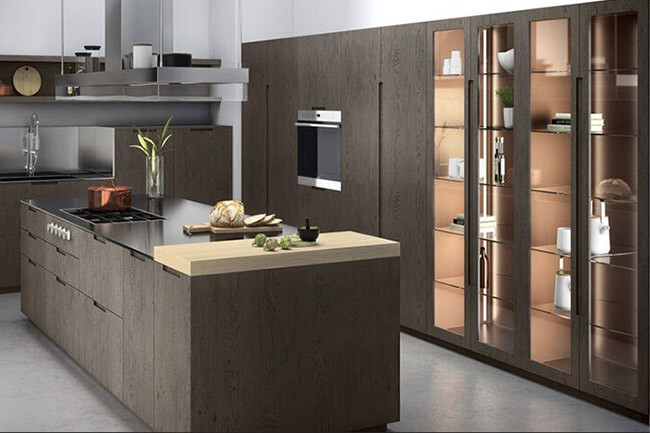
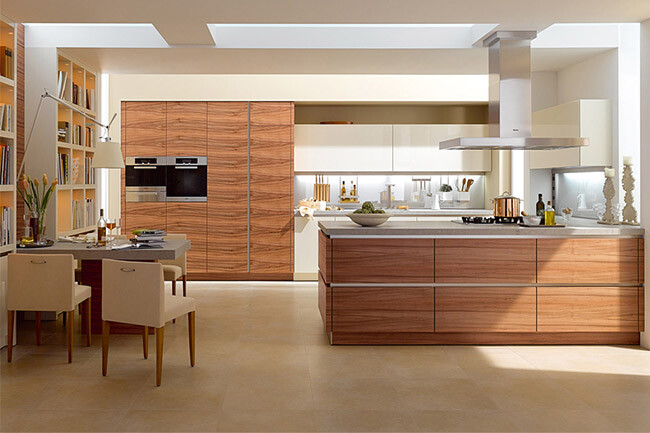
Wood veneer can be used in traditional designs, but it is especially popular for modern kitchen cabinets with smooth doors and long uninterrupted grain patterns.
How Wood Veneer Kitchen Cabinets Are Made
The process starts by selecting and preparing a log. Thin sheets are produced by slicing or peeling the wood. The cutting method affects the final grain pattern.
Rotary cutting produces wider and more varied grain patterns. Plain slicing often creates familiar cathedral shaped patterns. Quarter cutting and rift cutting can produce straighter and more consistent lines.
The sheets are dried and sorted before being arranged for the required appearance. They can be placed in sequence so the grain flows naturally from one cabinet door to the next. This is often called grain matching.
The selected veneer is bonded to a core panel using pressure and adhesive. Edges are then covered and sealed to protect the panel. Finally, the surface is stained, lacquered, oiled or coated with another protective finish.
The quality of each step matters. Poor bonding may lead to bubbles or lifting, while weak edge protection can allow moisture to reach the core.
Choosing The Right Cabinet Core
The veneer creates the visible finish, but the core provides most of the structure. MDF plywood and particleboard are commonly used for wood veneer cabinets.
The Composite Panel Association explains that MDF and particleboard provide flat and uniform surfaces that work well under decorative veneer. The best option depends on the cabinet design, budget and expected use.
MDF Core For Smooth Modern Doors
MDF has a smooth and consistent surface without natural knots or grain. This makes it suitable for flat veneer cabinet doors and precisely machined designs.
It can create a clean and even finish, but standard MDF must be protected from water. Moisture resistant grades may be more suitable for areas where humidity is a concern.
Plywood Core For Strong Cabinet Construction
Plywood is made from several layers of wood veneer bonded in alternating directions. A good quality plywood core can provide strength and reliable screw holding.
It is often selected for cabinet boxes and projects where buyers want a stronger engineered wood construction. Quality and moisture resistance can still vary between different plywood grades.
Particleboard Core For Budget Conscious Projects
Particleboard can create a flat and affordable base for wood veneer. It is commonly used in furniture and cabinet manufacturing.
However, exposed particleboard can swell if water enters through an unsealed edge or damaged surface. The board grade, density and edge sealing should therefore be checked before ordering.
Wood Veneer Cabinets And Solid Wood Cabinets Compared

Both options use genuine wood, but their construction and performance are different.
| Feature | Wood Veneer Cabinets | Solid Wood Cabinets |
|---|---|---|
| Surface | Thin layer of genuine wood | Solid pieces of timber |
| Core | MDF plywood or particleboard | Natural wood |
| Appearance | Natural grain with controlled matching | Natural grain with greater variation |
| Stability | Usually stable across wide flat surfaces | Can expand and contract with humidity |
| Cost | Usually more affordable | Usually more expensive |
| Repair | Minor repairs may be possible | Can often be sanded and refinished |
| Design use | Well suited to flat modern doors | Common in framed and traditional doors |
| Material use | Uses less premium timber | Requires more timber |
Solid wood is valued for its depth, feel and repair potential. However, natural timber moves as humidity changes. This can make large solid wood slab doors more difficult to control.
Wood veneer uses a stable panel underneath the natural surface. It is often a practical choice for large doors, modern designs and projects that need consistent grain across several cabinets.
Buyers who want to explore the alternative can learn more about solid wood kitchen cabinets.
Wood Veneer Cabinets And Laminate Cabinets Compared
The main difference is the surface material. Wood veneer uses genuine timber, while laminate uses a manufactured decorative layer.
Laminate can provide strong resistance to stains and daily wear, especially when a good quality high pressure laminate is used. It also offers more control over colour and pattern because every sheet can look almost identical.
Wood veneer feels warmer and more natural. No two sheets are exactly the same, and the grain has a depth that a printed surface may not fully reproduce.
In general, laminate is suitable for buyers who want easy maintenance and a controlled finish. Wood veneer is better for those who want authentic timber grain and a more natural premium appearance.
Main Benefits Of Wood Veneer Kitchen Cabinets
Genuine Wood Appearance
Natural veneer keeps the grain, colour and texture of real timber. It can give a kitchen the appearance of solid wood without using solid boards for every surface.
Better Use Of Natural Timber
One log can produce many veneer sheets. This allows manufacturers to cover more cabinet surfaces with a smaller amount of decorative timber.
Responsible sourcing still matters. Buyers who require certified material should ask for valid documentation and chain of custody information instead of relying on a general environmental claim.
Good Stability Across Large Doors
The engineered core underneath the veneer can be more stable across wide flat surfaces than a single solid wood board. This is helpful for slab doors, tall cabinet panels and modern handleless kitchens.
Wide Choice Of Wood Species
Oak walnut ash maple cherry and other species can be used as decorative veneer. Buyers can select a light natural finish, a deep dark stain or a colour that works with the rest of the interior.
Flexible Grain Matching
Veneer sheets can be arranged so the grain continues across several doors. This produces a calm and connected appearance that is difficult to create with random pieces of solid wood.
Lower Cost Than Comparable Solid Wood
Wood veneer cabinets are normally more affordable than cabinets using the same wood species in solid form. The final difference depends on the core, species, veneer grade, finish, hardware and cabinet construction.
Possible Drawbacks Of Wood Veneer Cabinets
Wood veneer is thin, so deep sanding is normally not possible. Small scratches may be repaired, but severe damage can be difficult to remove without replacing the affected panel.
Water is another important concern. If moisture enters through an open joint, damaged finish or poorly sealed edge, the core may swell. This is especially serious with standard MDF and particleboard.
Colour variation should also be expected. Natural veneer comes from real trees, so grain and shade differences are part of the material. Direct sunlight may gradually change the colour.
Poor quality workmanship can lead to peeling, bubbles, visible glue lines or mismatched grain. These problems are not caused by veneer alone. They are often connected to weak adhesives, poor pressing, incorrect storage or inadequate edge sealing.
How Durable Are Wood Veneer Kitchen Cabinets
There is no single lifespan for every veneer kitchen. Durability depends on the complete cabinet construction rather than the surface alone.

High quality wood veneer cabinets can remain attractive for many years when they use a suitable core, strong adhesive, sealed edges and a protective finish. Hardware quality and installation also affect how long the kitchen performs.
The areas around sinks, dishwashers, kettles and cooking appliances need extra attention. Steam, standing water and excessive heat can damage both veneer and solid wood finishes.
Before buying, ask the manufacturer how the doors are sealed, which adhesive is used and whether the board is suitable for the expected humidity level. A sample door can also help you inspect the finish and edge quality before approving a large order.
Popular Wood Veneer Options For Kitchen Cabinets
Oak Veneer Kitchen Cabinets
Oak has a clear and familiar grain. Natural oak veneer kitchen cabinets can work in Scandinavian contemporary rustic and transitional interiors.
White oak is popular for light kitchens, while darker stains can create a richer and more traditional appearance.
Walnut Veneer Kitchen Cabinets
Walnut offers deep brown colours and expressive grain. It is commonly used in luxury kitchens, feature islands and modern flat panel cabinetry.
Because walnut can vary in colour, grain matching and sample approval are particularly important.
Ash Veneer Kitchen Cabinets
Ash usually has a light colour and visible grain. It can make a kitchen feel bright and natural while still giving the doors more character than a plain painted finish.
Maple Veneer Kitchen Cabinets
Maple has a smoother and more subtle grain than oak or ash. It suits buyers who want a clean wood finish without strong visual movement.
Cherry Veneer Kitchen Cabinets
Cherry is known for its warm colour, which can deepen over time. It is often used in classic and transitional kitchens.
Wood Veneer Grain And Finish Options
The same wood species can look very different depending on how it is cut, matched and finished.
Book matching places two consecutive veneer sheets next to each other like the pages of a book. This creates a mirrored pattern.
Slip matching places consecutive sheets in the same direction. It normally produces a more even and repeated flow.
Sequence matching keeps sheets in the order they were cut and arranges them across a group of panels. This can help the grain continue across several cabinet doors.
Clear finishes protect the surface while keeping the natural colour visible. Stains can make the wood lighter, darker or warmer. Matte finishes create a soft modern appearance, while higher gloss finishes reflect more light.
Always approve a physical sample when colour accuracy is important. Screen images and small samples may not show the full amount of natural variation.
Wood Veneer Kitchen Cabinet Cost
The cost of wood veneer kitchen cabinets depends on more than the surface material.
Important pricing factors include:
- Cabinet dimensions and layout
- Wood species and veneer grade
- MDF plywood or particleboard core
- Veneer thickness and grain matching
- Door style and edge construction
- Stain and protective finish
- Hinges drawer systems and internal fittings
- Order quantity
- Custom packaging and shipping requirements
- Installation and local labour
Veneer is usually more expensive than basic laminate because it uses genuine wood and requires more careful selection and finishing. It is normally less expensive than comparable solid wood cabinetry.
For custom projects, a useful quotation should explain exactly what is included. Buyers should compare the cabinet core, door construction, hardware, finish and shipping terms instead of comparing only the final price.
How To Choose High Quality Wood Veneer Cabinets
Ask the following questions before placing an order:
- What wood species and veneer grade will be used
- What is the specified veneer thickness
- Is the core MDF plywood or particleboard
- Is a moisture resistant core available
- How are exposed edges sealed
- Which adhesive and pressing process are used
- Is the grain randomly matched or sequence matched
- Which stain and protective coating will be applied
- Can a physical sample door be approved
- What hardware brands and models are included
- What quality checks are completed before packing
- Which warranty terms apply to the order
Buyers importing cabinets into the United States should also ask whether regulated composite wood products meet applicable TSCA Title VI formaldehyde emission requirements. Similar requirements may apply in other markets, so documentation should match the destination country.
How To Clean Wood Veneer Kitchen Cabinets
Regular cleaning is simple when the veneer has a good protective finish.
Use a soft cloth with a small amount of mild soap and water. Wipe in the direction of the grain and dry the surface immediately.
Avoid soaking the doors or leaving water around the edges. Abrasive pads, strong chemicals and harsh degreasers can scratch or weaken the finish.
Grease should be removed before it builds up. Always test a new cleaning product on a hidden area and follow the finish supplier’s instructions.
Direct sunlight can gradually change natural wood colour. Blinds, curtains or ultraviolet protective window treatments may help reduce uneven colour changes in kitchens with strong sunlight.
Buying Custom Wood Veneer Cabinets From China
Ordering kitchen cabinets from China can give developers, contractors and homeowners access to custom sizes, finishes and internal storage options. Clear specifications are essential for getting the expected result.
Start with accurate room measurements, drawings or architectural plans. Confirm the cabinet dimensions, door opening direction, appliance sizes, plumbing positions and installation requirements.
Request material samples before approving production. The sample should show the veneer species, stain colour, surface sheen, grain direction and edge finish.
The quotation should also identify the core material, hardware, packaging, delivery terms and expected production schedule. These details help buyers compare suppliers fairly and reduce misunderstandings later.
Custom Wood Veneer Kitchen Cabinets From Parlunbuilding
Parlunbuilding helps buyers plan custom kitchen cabinets for individual homes and larger building projects. Cabinet dimensions, layouts, wood veneer finishes, hardware and storage features can be discussed according to the project requirements.
Buyers can explore the complete kitchen cabinet collection and learn more about Parlunbuilding quality standards before making a decision.
If you already have a floor plan, cabinet schedule or inspiration images, send them to the Parlunbuilding team. You can request a free catalogue and project quotation based on your design, quantity and destination.