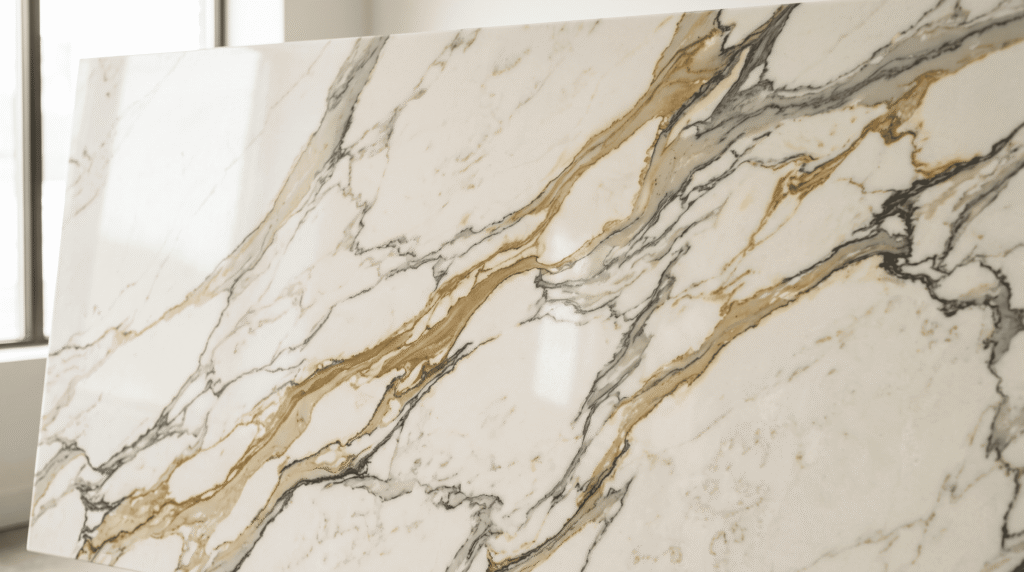
Calacatta gold quartz has become one of the most requested countertop materials in kitchen design, and it is easy to understand why. The warm white background layered with soft gold and grey veining delivers the visual drama of natural marble without the sealing schedules, acid sensitivity or unpredictable pattern variation that come with the real stone. Whether you are fitting a kitchen from scratch or replacing an existing worktop, this guide covers Calacatta gold quartz from material performance and maintenance to cabinet pairings, backsplash ideas and how to choose the right slab for your project.
Quick Summary of Calacatta Gold Quartz
Calacatta gold quartz is an engineered stone surface designed to replicate the look of natural Calacatta marble, with a warm white base and distinctive gold and grey veining. Unlike marble, it is non-porous, which means it does not absorb red wine, coffee or cooking oils and requires no annual sealing. Daily cleaning needs nothing more than mild soap and warm water.
The surface pairs naturally with white, cream, beige and natural wood cabinets, where warm undertones complement rather than compete with the stone. Navy, walnut and black cabinets create a bolder contrast that suits contemporary and transitional kitchens. Brushed brass and warm gold hardware are the most popular choices to connect the veining to the cabinet finish. For the backsplash, warm white tile is the safest option, while a full-height panel in the same quartz creates a seamless, more dramatic effect.
The main trade-off against real marble is pattern consistency. Every quartz slab from the same design looks broadly similar, which removes the uniqueness of natural stone but makes planning a predictable, repeatable layout significantly easier.
What Calacatta Gold Quartz Is
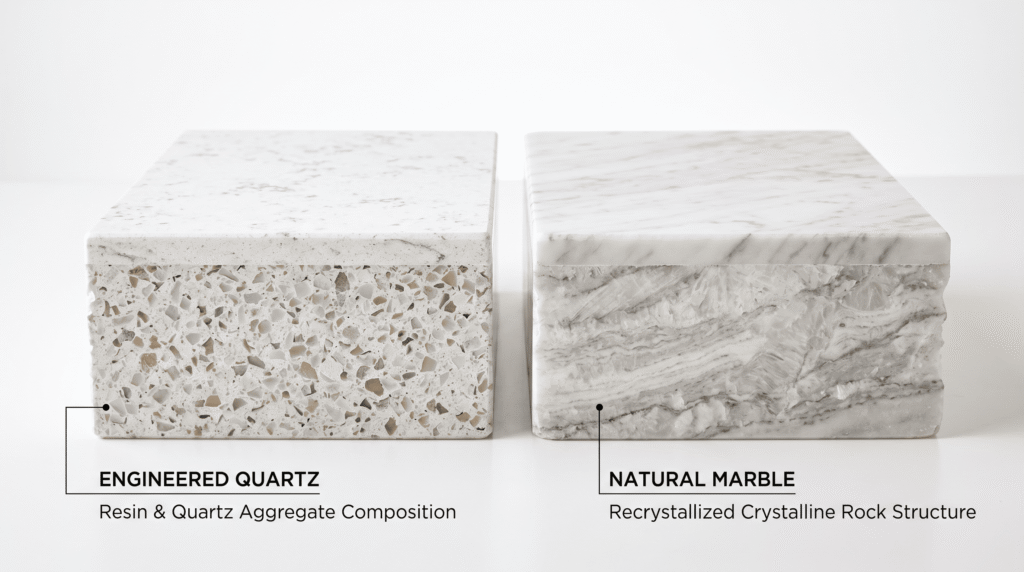
Calacatta gold quartz is a man-made engineered stone surface composed of approximately 90 per cent crushed natural quartz bound with polymer resin and pigments. The name refers to its design inspiration: the white marble quarried in the Apuan Alps near Carrara, Italy. For a full overview of the natural stone, see our Calacatta marble guide.
It is worth distinguishing Calacatta from Carrara marble. Carrara marble has fine grey veining on a white to blue-grey background. Calacatta marble has bolder, more pronounced veining in gold and grey tones on a brighter, whiter base. Calacatta gold quartz replicates the latter. The word “gold” refers to the warm amber and ochre tones in the veining, not to a metallic surface finish.
Because it is engineered, Calacatta gold quartz is non-porous. Liquids cannot penetrate the surface the way they do in natural stone. This is the single most significant practical difference between the two materials for everyday kitchen use.
Calacatta Gold Quartz Compared with Real Marble
The decision between Calacatta gold quartz and real Calacatta marble comes down to four practical factors: maintenance, pattern, heat resistance and budget.
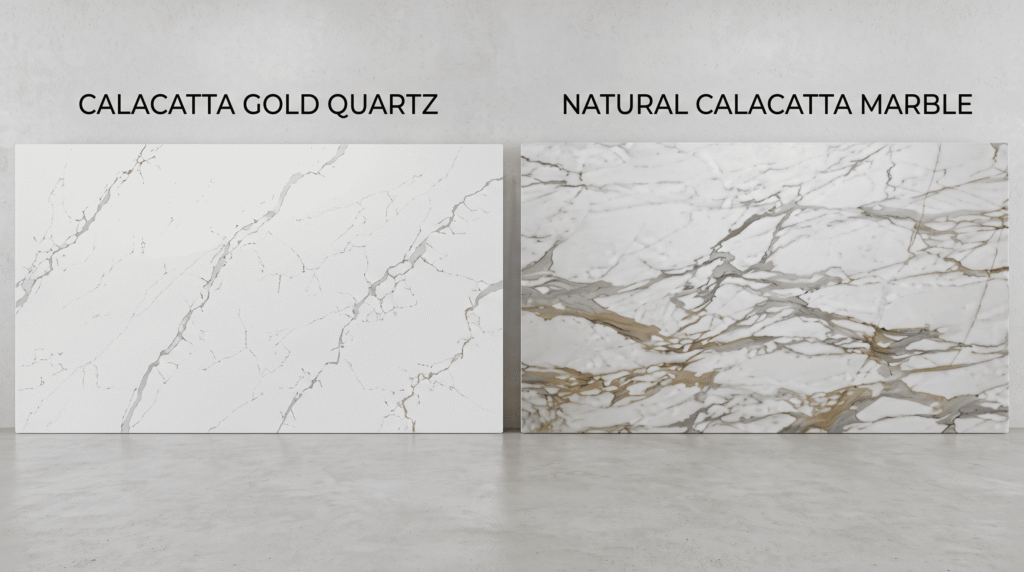
Natural Calacatta marble is porous. It absorbs liquids, requires annual sealing and is vulnerable to etching from acidic foods and drinks including lemon juice, vinegar and wine. Over time, an unsealed marble surface develops a patina that some owners welcome and others find difficult to manage.
Calacatta gold quartz is non-porous. It does not absorb liquids, requires no sealing and resists staining under normal kitchen conditions. The surface holds its colour and sheen without intervention.
The key trade-off is heat sensitivity. Engineered quartz contains resin binders that can discolour or crack under sudden heat above approximately 150°C. Trivets and heat pads are essential. Natural marble handles direct heat better, though prolonged exposure can still cause damage to either surface.
|
|
Calacatta Gold Quartz |
Natural Calacatta Marble |
|---|---|---|
|
Porosity |
Non-porous |
Porous, requires sealing |
|
Maintenance |
Wipe clean, no sealing |
Annual sealing, avoid acids |
|
Pattern |
Consistent per design |
Unique per slab |
|
Heat resistance |
Low — use trivets above 150°C |
Moderate |
|
Stain resistance |
High |
Lower without sealing |
|
Damage repair |
Difficult to match |
Polish and refinish |
|
Price range |
Mid to high |
High to very high |
Best Cabinet Colors for Calacatta Gold Quartz
The warm, veined surface of Calacatta gold quartz responds differently to different cabinet colours. Getting the undertone right matters more than matching colours exactly.
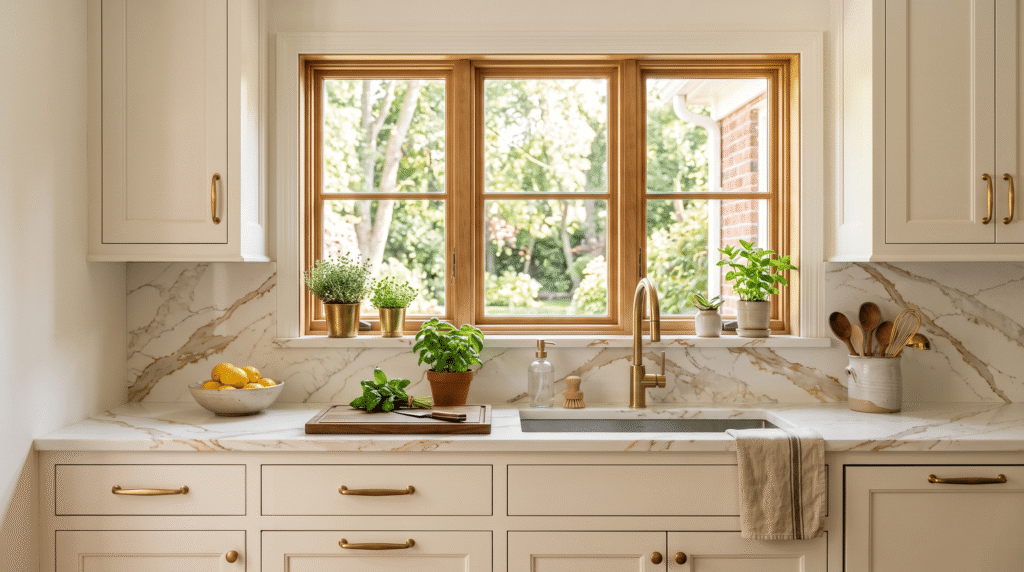
White and Warm White Cabinets
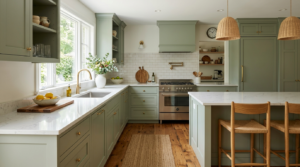
Pure white cabinets are the most common pairing. The key is undertone. Cool stark white can make the warm gold veining look out of place. Warm white and off-white tones complement the quartz without competing. Brushed brass or warm gold hardware reinforces the connection. See our guide to white kitchen cabinets for finish and door style options.
Cream and Beige Cabinets
Cream and beige cabinets sit naturally alongside Calacatta gold quartz. The warmer the cabinet tone, the more the gold veining feels deliberate rather than incidental. This combination suits traditional, transitional and farmhouse kitchens. Antique brass or unlacquered brass hardware works particularly well in these settings.
Natural Wood and Oak Cabinets
Natural oak and light timber cabinets bring warmth and organic texture that complements the movement in the veining without feeling contrived. The grain of the wood and the flow of the stone share a natural visual language. Matte black or aged brass hardware bridges the two materials cleanly.
Walnut Cabinets
Walnut’s deep, warm brown creates a rich contrast with the bright white quartz background. The gold veining connects the two tones visually. This pairing suits contemporary and mid-century modern kitchens. Brushed brass hardware is the natural choice. For styling ideas, see our walnut kitchen cabinets guide.
Navy Black and Green Cabinets
Dark cabinet colours including navy, forest green and matte black create a high-contrast pairing that suits statement kitchens. The white quartz background stays prominent against dark base cabinets, while the gold veining adds visual warmth that stops the look from feeling stark. Polished or brushed brass hardware ties the combination together.
Cabinet colour pairing at a glance:
|
Cabinet Colour |
Undertone Match |
Hardware Suggestion |
|---|---|---|
|
Warm white |
Natural complement |
Brushed brass or gold |
|
Cream |
Seamless warmth |
Antique or unlacquered brass |
|
Beige |
Soft and natural |
Brushed gold |
|
Natural oak |
Organic warmth |
Matte black or aged brass |
|
Walnut |
Rich warm contrast |
Brushed brass |
|
Navy |
Bold contrast |
Polished or brushed brass |
|
Black |
High contrast |
Brushed or polished gold |
|
Sage green |
Soft earthy contrast |
Brushed brass |
Backsplash and Island Ideas
The backsplash decision hinges on how much pattern movement the quartz already brings. A heavily veined slab needs a quieter backsplash to avoid visual overload. A more restrained slab can carry a more textured backsplash treatment.
Same Slab Full Height Backsplash
Extending the Calacatta gold quartz up the wall behind the hob as a full-height panel creates a seamless, dramatic effect. It works best when the countertop has moderate rather than heavy veining. Seam placement needs careful planning with the fabricator.
Warm White Tile
A plain warm white ceramic or porcelain tile lets the quartz be the focal point of the kitchen. Subway tile, handmade white tile and plaster-finish tiles all hold their own without introducing a competing pattern. This is the most versatile and widely applicable choice.
Zellige
Handmade Moroccan zellige tiles in warm white or cream add texture and artisan quality without a busy printed pattern. The irregular surface catches light differently from the polished quartz and creates a complementary contrast in quality and character.
Glass and Stone Mosaics
White or warm neutral glass mosaic and stone mosaic tiles work where a subtle shimmer is wanted behind the hob. Keep the tone within the warm white to cream range to avoid pulling the eye away from the quartz. Avoid cool grey or silver mosaics, which can work against the warm veining.
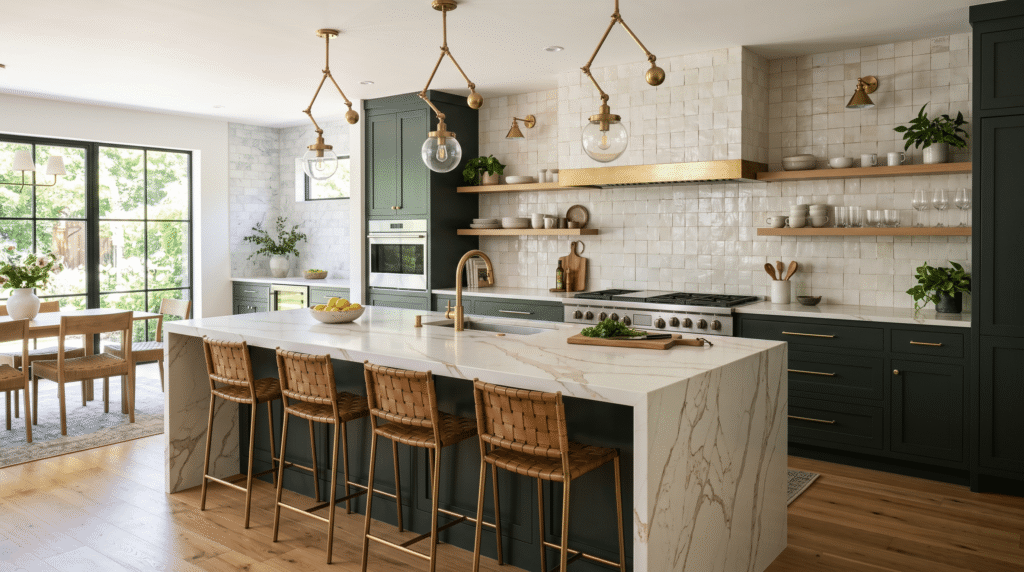
Waterfall Island
Extending the Calacatta gold quartz down the sides of a kitchen island as a waterfall creates a sculptural focal point. The dramatic veining reads well on vertical surfaces. Bookmatching adjacent slabs from the same slab pair maximises the visual effect on larger islands.
Edge Profiles Finishes and Vein Placement
Edge profile, surface finish and vein direction all affect the final result as much as the slab pattern itself. These decisions should be made before the fabricator templates the kitchen.
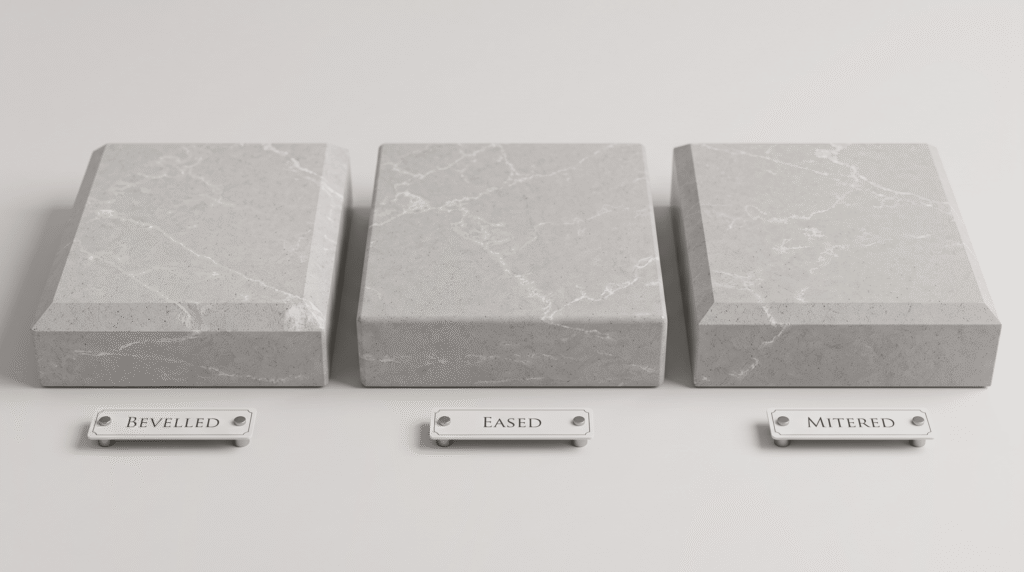
Edge Profiles
The eased edge, a slightly softened square profile, is the most common choice and suits both contemporary and transitional kitchens. A mitered edge, where two pieces are joined at 45 degrees to create the appearance of a thick slab, works well for waterfall islands. A bevelled or pencil edge suits traditional kitchens. Avoid ornate ogee or rope profiles with a stone that already carries strong visual movement.
Surface Finish
A polished finish reflects light and heightens the visual drama of the veining. A honed finish gives a soft, matte appearance and is less likely to show fingerprints, though it may be more susceptible to surface marks over time. Confirm which finishes are available in your chosen design before ordering.
Vein Direction and Seams
Agree vein direction with your fabricator before templating begins. Horizontal veining lends a natural, relaxed feel. Vertical veining looks more structured and dramatic. On long countertop runs, confirm seam placement to avoid a visible seam running through a prominent area of the surface. On large islands, ask whether bookmatching from a single slab pair is possible.
Cleaning Durability and Daily Use
Calacatta gold quartz is one of the lower-maintenance countertop surfaces available, but it has specific limitations that are worth understanding before purchase.
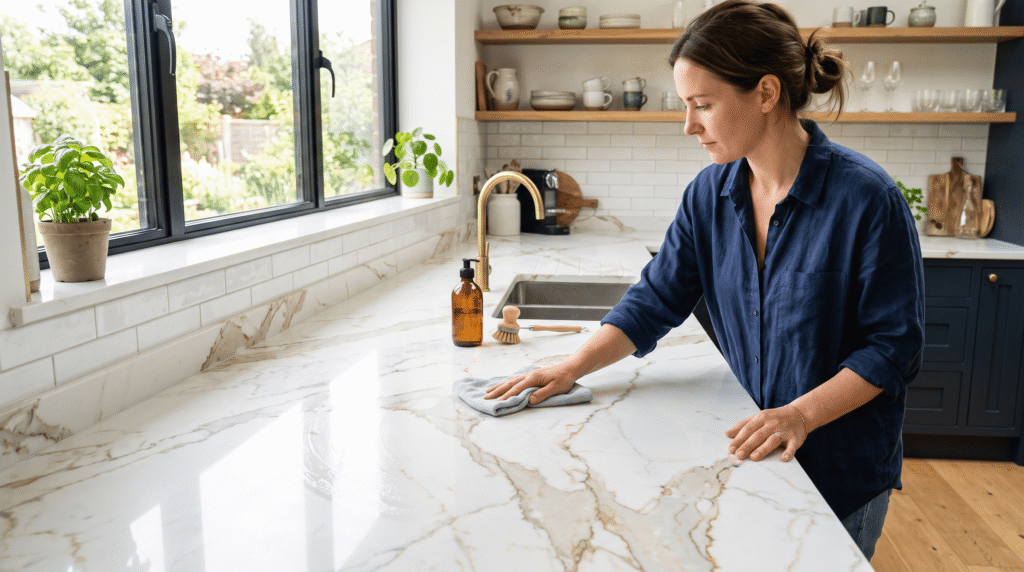
Routine Cleaning
Mild dish soap and warm water are sufficient for daily cleaning. Avoid abrasive cleaners, steel wool and harsh chemicals including bleach and high-pH degreasers, which can dull the surface over time. For stubborn residue, a non-abrasive surface cleaner designed for engineered stone is safe to use.
Heat and Scratching
Do not place hot pans directly on the surface. The resin binders in engineered quartz can crack or discolour under sudden heat above approximately 150°C. Always use a trivet or heat pad. Quartz is harder than most kitchen surfaces and resists everyday scratching, but sharp knives used directly on the surface without a board will eventually mark it.
Warranty
Most major quartz manufacturers offer a limited lifetime warranty covering manufacturing defects. Read the terms carefully before purchasing. Damage caused by heat, impact, harsh chemicals or improper cleaning is typically excluded from coverage.
How to Choose a Calacatta Gold Quartz Slab
Slab selection is where many buyers make avoidable mistakes. A small tile sample from a showroom does not represent how a full countertop will look in your kitchen.
Once the slab is chosen, the cabinet colour and door profile need to work with it from the start. Parlun Building manufactures custom kitchen cabinets factory-direct from Foshan, covering the full range of finishes that pair best with Calacatta gold quartz. Request a free design consultation to discuss cabinet and countertop selections together.