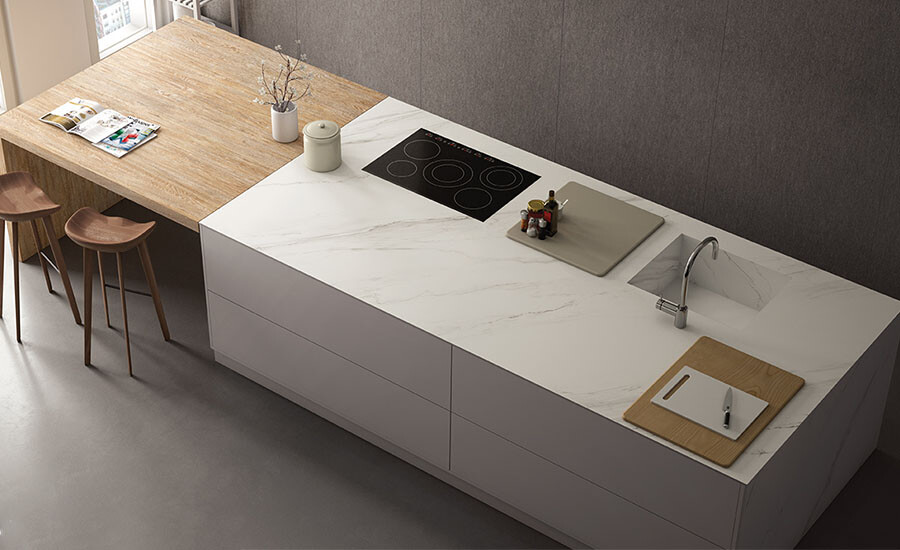
Ceramics are versatile. In everyday life, it can be used as floor tiles, roof tiles, and kitchen countertops. Ceramic countertops have been a favorite for many years. So what makes ceramic countertops so attractive in the kitchen? Are they reasonably priced?
High-strength ceramic countertops.
High-strength ceramics can be cut down to very thin worktops. They look elegant and make the kitchen look less bulky. It can also be used throughout the niches and furniture fronts. Together with the worktop, it creates a harmonious look in the kitchen. At the same time, ceramics are perfect for kitchen islands in open living concepts.

The multifunctional design of ceramic countertops
Many well-known manufacturers from China, such as Parlun, already have many decorations for their ceramic countertops. You can choose from a wide range of colors and variants with distinct textures and structures. With ceramic countertops, you can easily make your kitchen full of charm.

What are the advantages and disadvantages of ceramic as a countertop material?
Ceramic countertops are very hard and have a strong, hard-wearing surface. It is cut abrasion and heat resistant. Because ceramic kitchen countertops do not absorb any liquids, they require little maintenance. Ceramics does not absorb odors, emit any substances, or provide a breeding ground for bacteria, germs, or mold. As a result, ceramic is considered very hygienic. Most importantly, ceramics do not discolor because they are UV resistant.
Ceramics is expensive to purchase, but it is extremely durable and easy to care for. Therefore, ceramics can last a long time. So it is worth the investment.

Tip: If you can accept the high cost of ceramic, you can consult Parlun and find cost-effective discounted kitchens with ceramic countertops.
Advantages of ceramics | Disadvantages of ceramic |
Strong, cut, and abrasion resistant | Very high purchase price |
Heat resistant | Long waiting time |
Easy to care for | |
Non-porous surface, hygienic | |
Insensitive to water and acids | |
Noble and high quality optics | |
Very thin ceramic countertops can be produced | |
Light resistant | |
Multifunctional design |
Cleaning of ceramic countertops
Ceramic countertops don’t take much time to maintain and clean. A damp cloth is enough to remove cooking marks. A mild detergent helps to remove stubborn stains.
Tip: In contrast to other materials such as natural stone or concrete, ceramic surfaces do not have to be impregnated.
Manufacture of ceramics countertops
Ceramics consist of a mixture of various finely ground clay materials, which is known as fine stoneware. In countertop production, ceramic stoneware is pressed into thin sheets and fired at high temperatures. After starting the firing process, a thin, glassy and extremely smooth surface layer is formed on the plate to seal the ceramic body.
Tip: Due to the manufacturing process, ceramic countertops have a high degree of hardness, so they are ideal for use as kitchen countertops.