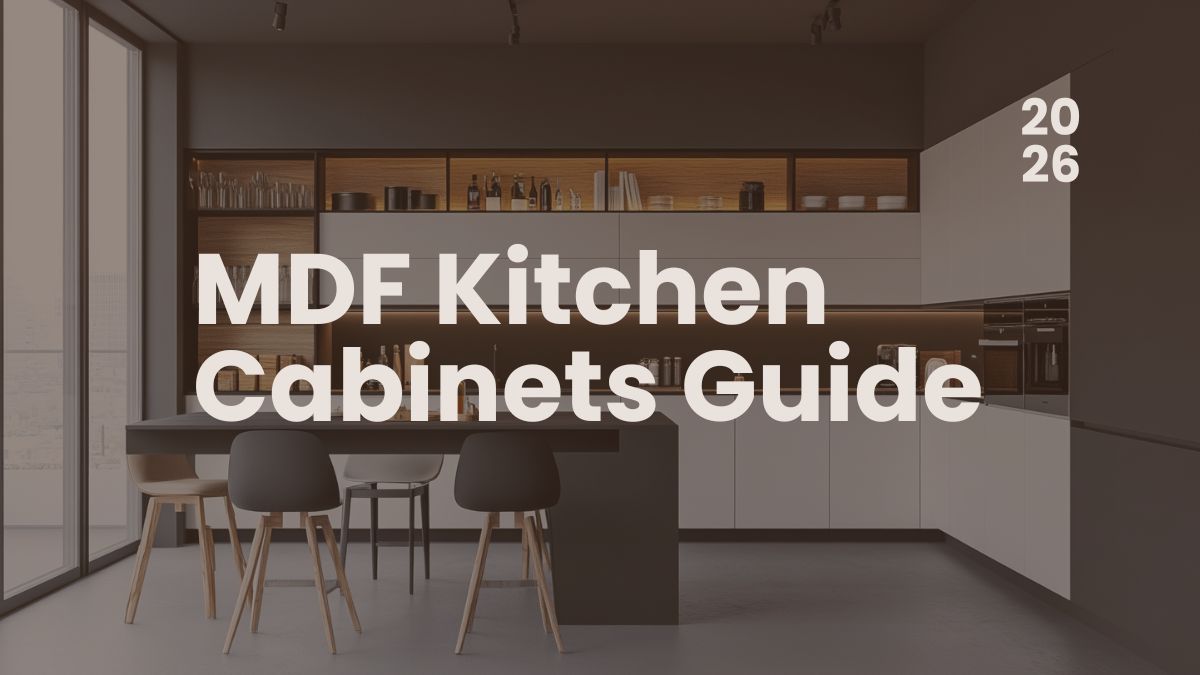
MDF kitchen cabinets are everywhere in modern homes, yet the material is often misunderstood. Some people treat MDF as a cheap shortcut, while others swear by the flawless painted doors it produces. Both reactions miss the point. MDF performs well or badly depending on three things: where it is used, how the edges are sealed, and the quality of the finish. Get those right and MDF gives you smooth, stable, budget friendly cabinets. Get them wrong and you invite swelling and chipping. This guide walks through what MDF actually is, its real strengths and weak spots, how it compares with other materials, and how to buy MDF cabinets that hold up for years.
Quick Summary of MDF Kitchen Cabinets
Here is the fast verdict. MDF kitchen cabinets shine as painted doors and decorative panels because the surface is perfectly smooth with no wood grain to show through. MDF is dimensionally stable, so painted finishes crack less than they do on solid wood, and it carves cleanly into detailed door profiles. It also costs less than plywood or hardwood.
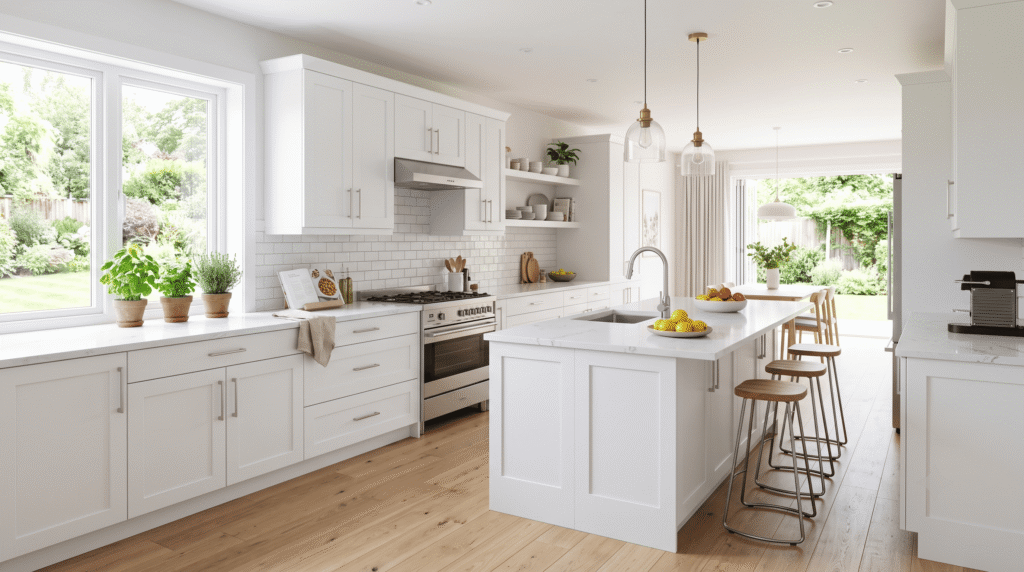
The trade offs are real. Raw MDF soaks up water at unsealed edges, it is heavy, it holds screws less securely than plywood, and it is hard to repair once chipped. The premium answer most professionals reach for is a hybrid build. Use a plywood or moisture resistant box for strength where spills happen, and painted MDF doors for the smooth look up front. That combination balances durability, appearance, and budget better than any single material can manage on its own, which is why it has become the go to choice for quality kitchens.
What MDF Is and How It Is Made
MDF stands for medium density fiberboard. It starts with softwood and hardwood broken down into fine fibers, which are mixed with resin and wax, then pressed under high heat and pressure into a dense, uniform panel. There are no knots, no grain direction, and no hollow spots inside. That uniform core is why the faces come out glass smooth, which is the single biggest reason MDF is chosen for painted cabinet doors.
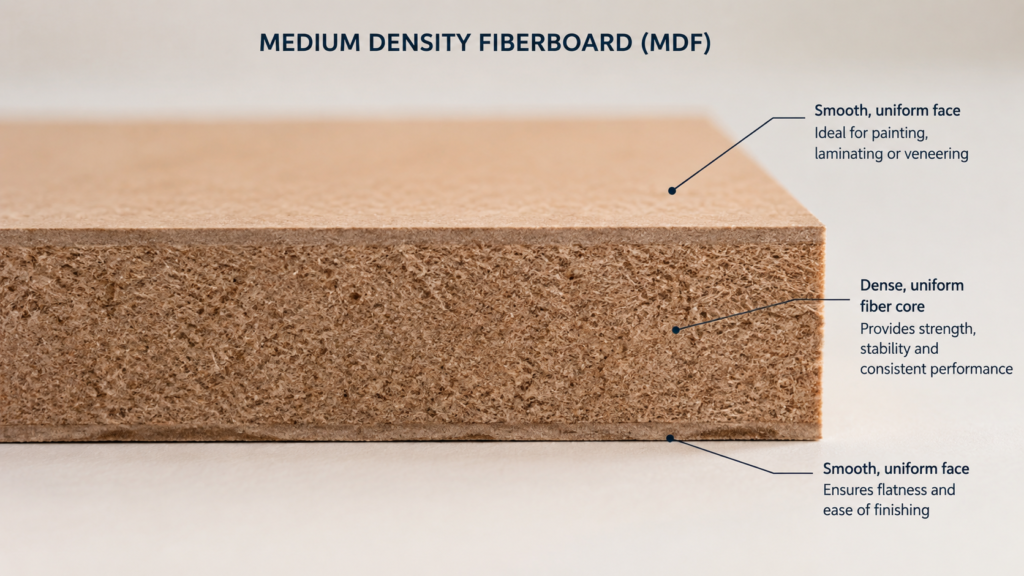
The material comes in grades. Standard MDF suits interior doors and panels. Moisture resistant MDF, often dyed green, uses a tougher resin for damper zones. Thin MDF, defined as eight millimeters or less, shows up in back panels and drawer bottoms. Understanding these grades matters, because a good MDF cabinet uses the right grade in the right place rather than one panel type for the whole box.
Advantages of MDF Kitchen Cabinets
The smooth paint finish is the headline benefit. Because there is no grain to telegraph through the coating, a painted MDF door looks cleaner than painted solid wood, with no raised lines appearing months later. For anyone who wants crisp white or bold colored cabinets, MDF is hard to beat.
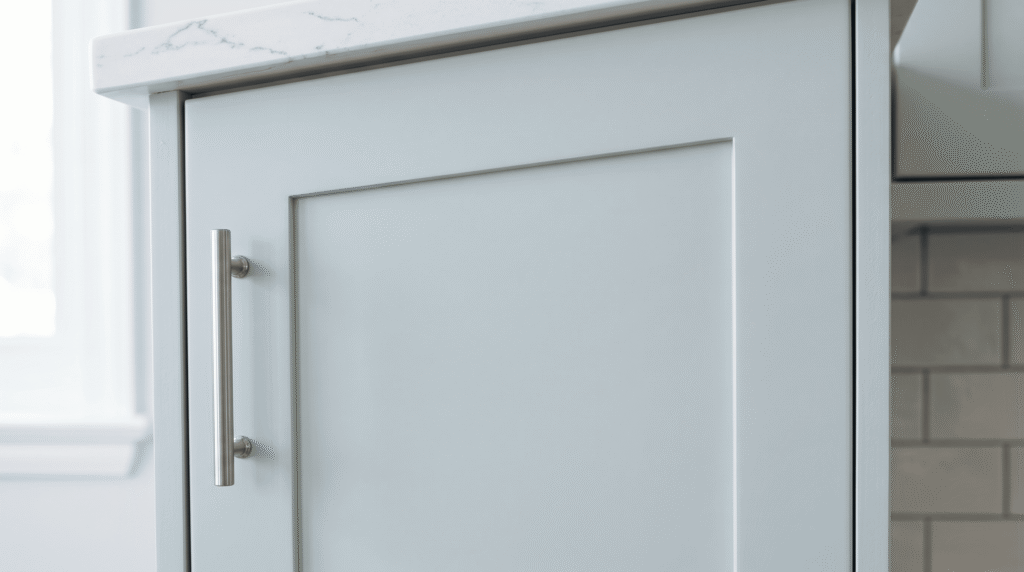
Dimensional stability is the quiet advantage. MDF resists the expansion and contraction that humidity swings cause in solid wood, so painted surfaces are far less likely to crack at the joints over time. A one piece routed MDF shaker door has no seams to open up, while a five piece wood door can show hairline gaps where the rails meet the stiles.
Design flexibility is another strong point. MDF machines cleanly, so it carves into shaker, beaded, and raised panel profiles from a single solid piece. It is also consistent from panel to panel, which keeps large kitchens looking uniform. On top of all that, MDF costs noticeably less than plywood or hardwood, which frees up budget for better hinges, nicer hardware, or a proper factory finish.
Disadvantages of MDF Kitchen Cabinets
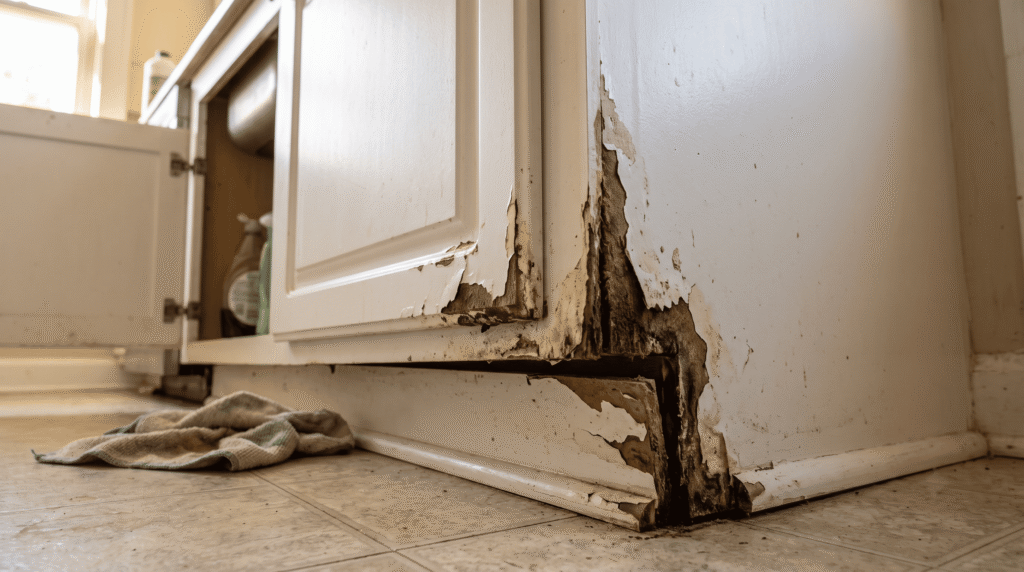
Moisture is the main weakness, and it lives at the edges. Raw, unsealed MDF acts like a sponge. If water sits against an exposed edge near a sink or dishwasher, the panel swells and the damage cannot be undone. This is why sealing and placement matter so much, and why raw MDF should never be used unprotected in a sink base.
Weight is the next issue. MDF is denser and heavier than plywood, so tall doors and wide panels put more strain on hinges. Cheap hinges sag under that load, which is why quality soft close hardware is not optional on heavier MDF doors.
Screw holding is weaker too. MDF grips screws reasonably well the first time, but strip a hole once and it is hard to re anchor without glue or inserts. Edges and corners also dent and chip more easily than solid wood, and unlike wood you cannot sand a scratch away.
Damage is hard to hide once it happens. MDF also dislikes sustained high heat. Sealed MDF handles all of this far better than raw MDF, so the finish quality is what separates a lasting cabinet from a disappointing one.
MDF Compared with Plywood Solid Wood and Particle Board
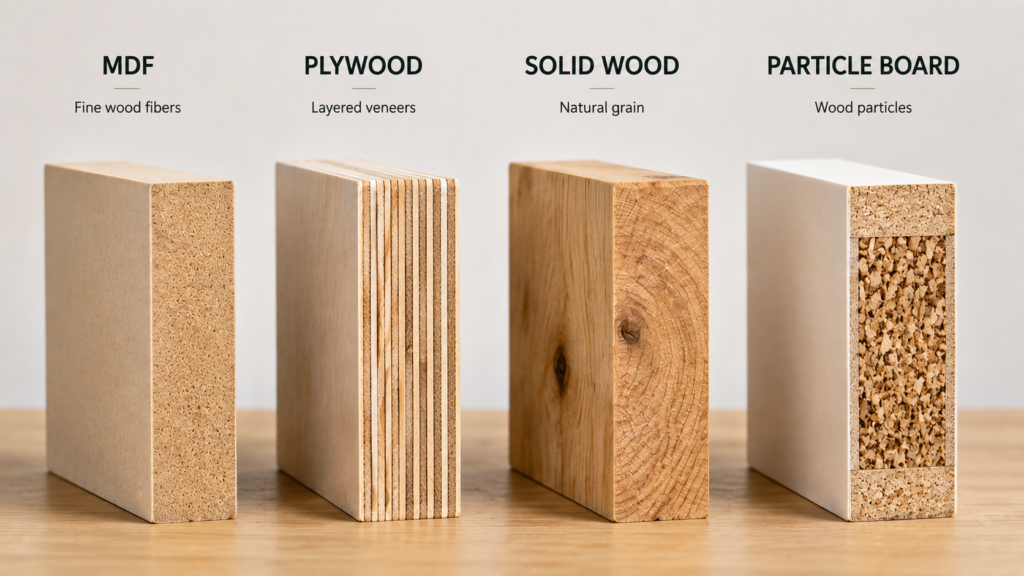
Every material has a job it does best. MDF wins on smooth painted surfaces and price. Plywood wins on strength, weight, and moisture resistance, which is why it is the default for cabinet boxes. Solid wood offers the longest life and can be refinished many times, at the highest cost. Particle board is the cheapest option, but it is the weakest and the most vulnerable to water. The table below sums up how they stack up on the factors that matter in a kitchen.
|
MDF |
Plywood |
Solid Wood |
Particle Board |
|
|---|---|---|---|---|
|
Structural strength |
Moderate |
High |
High |
Low |
|
Moisture resistance |
Low raw, good if sealed |
Good |
Good |
Poor |
|
Paint finish |
Extremely smooth |
Good |
Good with grain |
Fair |
|
Screw holding |
Moderate |
Strong |
Strong |
Weak |
|
Weight |
Heavy |
Lighter |
Heavy |
Moderate |
|
Relative price |
Low |
Higher |
Highest |
Lowest |
|
Best use |
Painted doors and panels |
Cabinet boxes |
Frames and heirloom pieces |
Budget flat panels |
The practical takeaway is that no single material is right for the whole kitchen. Matching each part to the material that suits it gives you the best result. For a deeper look at box material, see the Parlun plywood cabinet guide.
Painted MDF Cabinet Doors and Finish Quality
A painted MDF door is only as good as its finish process. Quality starts with a proper primer that seals the porous surface, followed by two or more top coats. The best factories spray a lacquer or two part polyurethane and bake it, which produces a hard, even, smooth surface that resists daily wear far better than a brushed on coat.
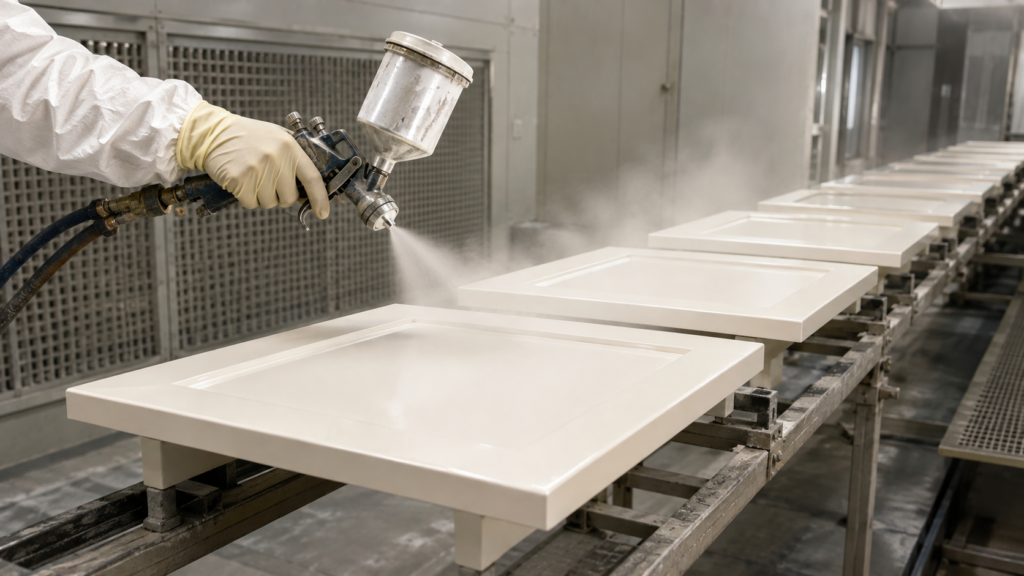
Edge sealing is the step that makes or breaks longevity. Cut MDF edges are the thirstiest part of the panel, so they must be sealed before painting or moisture will wick in from the bottom. Good doors feel smooth right to the corners with no rough or patchy spots.
Watch for warning signs when you inspect samples. Thin or uneven edge coating, visible swelling along a bottom edge, fasteners telegraphing through the paint, and an orange peel texture all point to a rushed finish. A well made painted MDF door should feel almost glass smooth with fully sealed edges. Compare it against a melamine cabinet guide finish if you want a lower maintenance alternative.
How to Choose MDF Cabinets That Last
Buying well comes down to checking the details that cheap cabinets skip. First, match the material to each component, then run through a quick inspection before you commit. The table shows the smart material choice by part, and the checklist covers what to verify on the actual cabinets.

|
Cabinet component |
Best material choice |
|---|---|
|
Cabinet box |
Plywood or moisture resistant MDF |
|
Painted doors |
MDF |
|
Sink base |
Plywood or sealed moisture resistant MDF |
|
Decorative molding |
MDF |
|
Drawer boxes |
Plywood or solid wood |
Use this inspection checklist before you buy:
Parlun MDF Cabinet Options
Parlun does not push one material for every job. We match the build to your project, which usually means a plywood or moisture resistant box for strength where spills happen, paired with smooth painted MDF doors for the look you want up front.
Every panel is a low emission grade, edges are properly sealed, and each order passes factory quality control before it ships. We also offer custom sizes and a wide range of finishes, so your cabinets fit your space instead of forcing you to adapt to stock sizes. Explore the full range on our main kitchen cabinets page, then request free door samples or book a design consultation to see and feel the finish before you order.