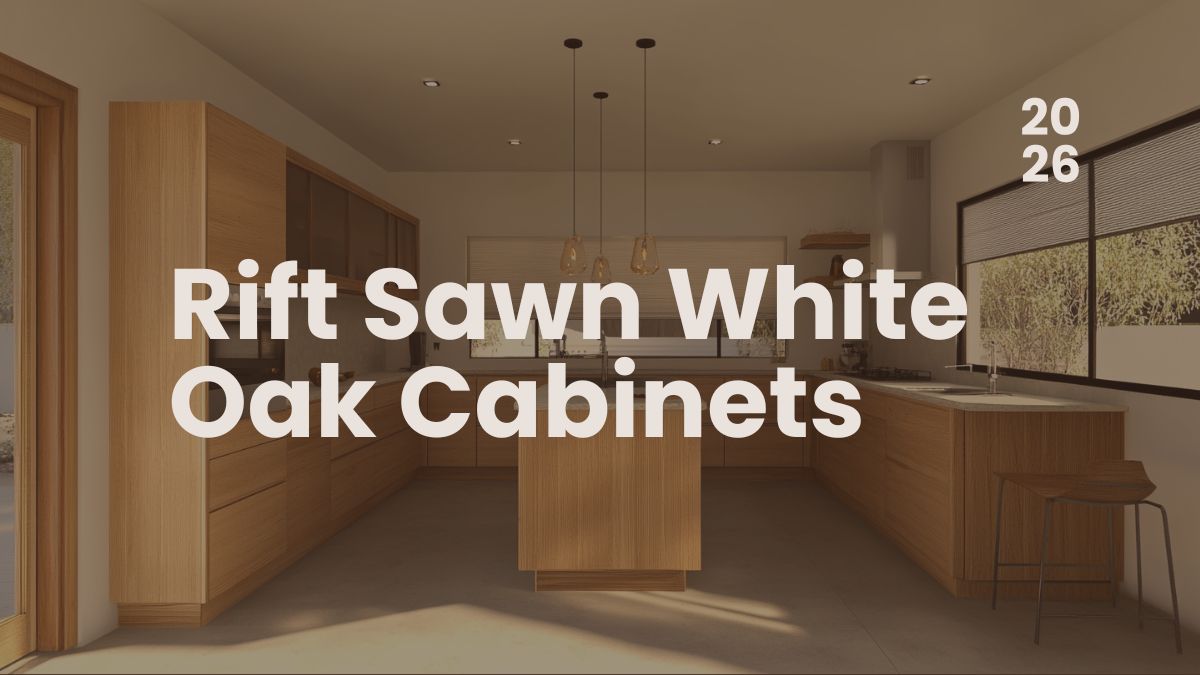
When architects and interior designers specify oak for a kitchen, most reach for rift cut white oak by name. The reason is grain consistency. Rift sawn oak cabinets deliver tight, straight, parallel grain across every door face, with none of the cathedral arch figuring that flat sawn produces. For a rift sawn white oak kitchen, that visual restraint is precisely the point. This guide explains the cutting method and why it costs more.
What Is Rift Sawn White Oak?
The term rift sawn refers to a specific method of milling timber from a log. In standard flat sawing, boards are cut in parallel slices straight across the log. In rift sawing, each board is cut at roughly 30 to 60 degrees relative to the annual growth rings. This angle means the growth rings run nearly perpendicular to the face of the board rather than across it.
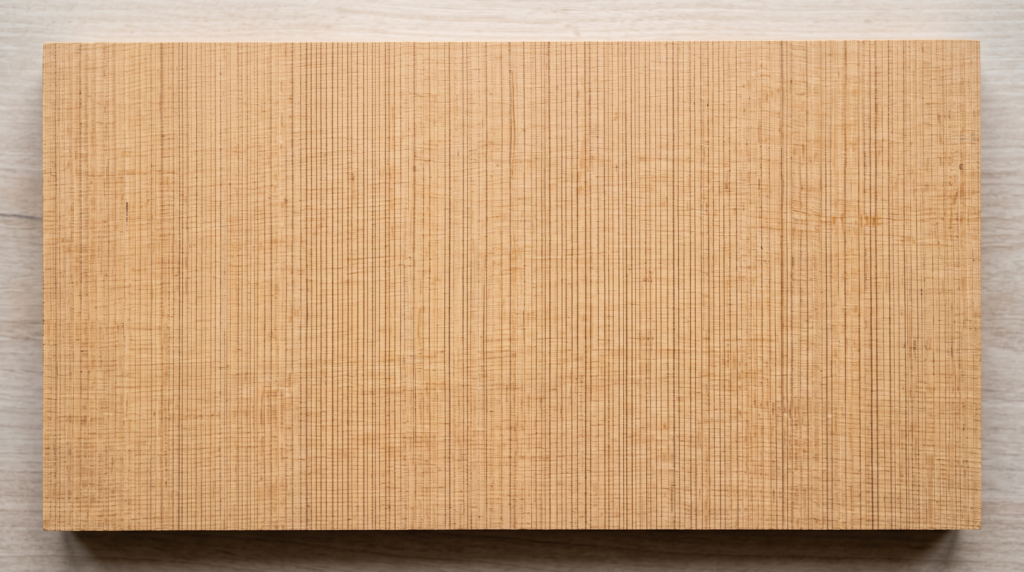
That orientation is what produces the characteristic rift cut oak grain pattern: tight, parallel lines that run consistently from top to bottom with no deviation. There is no cathedral arch, no medullary ray fleck, and no variation in grain direction between adjacent boards. Every door face looks deliberate and controlled.
The rift cut oak appearance is quieter and more architectural than flat sawn oak. It does not compete visually with other surfaces in the room. For kitchens with handle-free slab-front doors, or open shelving where grain continuity is visible across multiple cabinet runs, this consistency is a significant design advantage.
Producing rift sawn boards requires cutting at an angle that generates considerably more offcut waste than flat sawing. A millwright cutting rift sawn boards from the same log will yield far fewer usable pieces than if they cut straight through. That higher waste rate is the primary reason rift cut white oak costs more at every stage of the supply chain, from the mill to the finished cabinet.
White oak is the preferred species for this cut for practical as well as visual reasons. It has a denser cellular structure than red oak, with tyloses that fill the open pores and make the timber significantly more resistant to moisture. In a kitchen environment where steam and humidity are constant variables, white oak’s natural density is a real advantage. The rift sawn orientation compounds this by aligning the most stable grain angle with the face of the board.
Rift Sawn vs Flat Sawn vs Quarter Sawn: What’s the Difference?
Three main sawing methods are used for white oak, and each produces a distinctly different surface. Understanding the difference is essential before specifying material for a kitchen build.
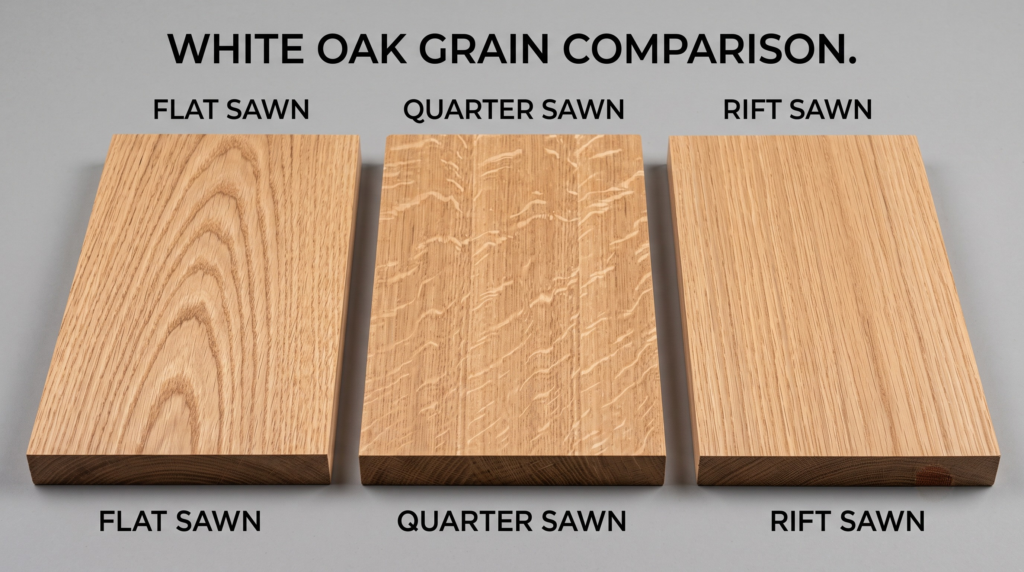
Flat sawn (plain sawn) is the most common and economical method. The log is cut in parallel slices, and most boards end up showing a cathedral arch or oval grain pattern on their face. This figuring is bold and immediately recognisable. Flat sawn oak suits farmhouse, rustic, and traditional kitchens where natural wood character is part of the intended aesthetic.
Quarter sawn white oak is cut at 60 to 90 degrees to the growth rings. This angle produces a straighter grain than flat sawn, along with the medullary ray fleck oak is well known for: a shimmering, ribbon-like pattern visible across the face. Quarter sawn is more expensive to produce than flat sawn, but considerably less wasteful than rift sawn. It suits craftsman, arts and crafts, and mid-century kitchens where a degree of surface figuring is appropriate and desirable.
Rift sawn is cut at 30 to 60 degrees, specifically to avoid both the cathedral arch of flat sawn and the fleck of quarter sawn. The surface is the most uniform of the three: straight grain only, with no figuring of any kind. Rift cut white oak is the most expensive to produce because the angled cuts waste the most timber per log.
For contemporary, minimal, and Japandi kitchens where surface uniformity matters above all else, the choice between rift sawn vs flat sawn is straightforward. Rift sawn is the specification that allows the material to carry the design without introducing visual noise or variation between cabinet doors.
Why Interior Designers Specify Rift Sawn Oak for Cabinets
The design case for rift sawn oak comes down to three qualities: visual consistency, material character, and dimensional stability.
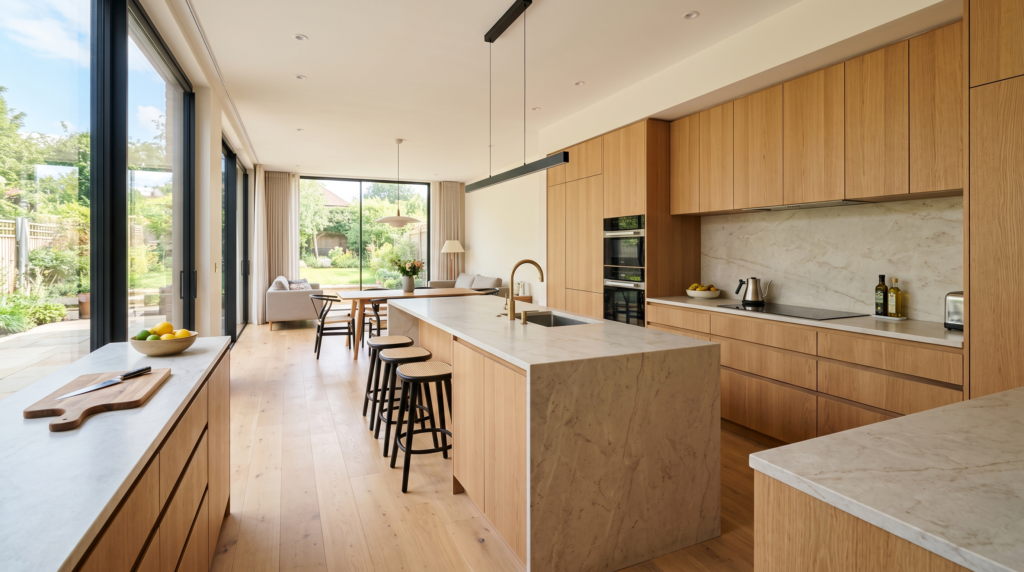
Visual consistency. In a rift sawn white oak kitchen, every cabinet door presents the same straight-grained surface. There are no grain direction changes between boards, no fleck, and no bold figuring. The cabinetry becomes a unified element in the room rather than a collection of individually varied pieces. This coherence matters especially in open-plan kitchens where the cabinetry is visible from multiple angles and sightlines at once.
Material character. Rift sawn oak has a restraint that flat sawn oak does not. The grain is present but never dominant. Paired with natural oil or a light stain finish, rift sawn oak cabinets carry a warmth that painted or lacquered cabinetry cannot replicate. The wood remains visibly present as a material without competing with countertops, flooring, or other surfaces sharing the space.
Dimensional stability. Compared to flat sawn oak, rift sawn boards expand and contract less across their width when ambient humidity changes. The angle at which the growth rings meet the board face limits lateral movement. For rift sawn oak cabinets exposed to daily fluctuations in kitchen steam and temperature, greater stability means tighter door tolerances and a reduced risk of warping over time.
These three factors together explain why rift cut white oak has become a standard specification among kitchen designers working in the high-end and contemporary segment. The premium over flat sawn oak is real, and so is the performance difference.
Rift Sawn White Oak Cabinet Styles
Rift sawn white oak can be worked into a range of door profiles. Two styles account for the majority of demand in contemporary rift sawn white oak kitchen design.
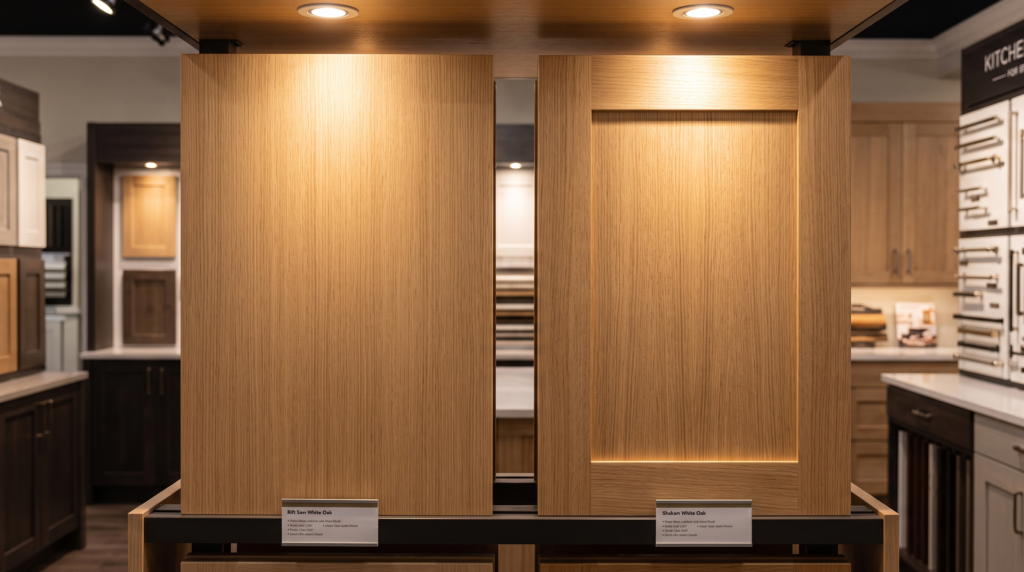
Rift Sawn Flat Panel Cabinets
Flat panel rift sawn cabinets are the most widely specified application of this wood cut. The door is a single flat face with no centre panel recess, no rail, and no stile. On a rift cut surface, the straight grain runs uninterrupted from top to bottom across the full door width.
This style suits ultra-modern kitchens, Japandi interiors, and any design scheme where minimal surface detail is the goal. Handle-free, push-to-open rift white oak flat panel doors pair naturally with matte stone countertops and integrated appliances. The grain does quiet visual work without introducing ornament or decoration.
Finish choices for flat panel rift sawn doors range from natural clear oil, which allows the timber to develop warmth over time, to wire-brushed or lye treatments that open the grain surface and shift the tone cooler and greyer. Both directions suit the straight grain of rift cut oak without competing with it.
Rift Sawn Shaker Cabinets
Rift sawn shaker cabinets pair the classic five-piece shaker frame with a rift-cut centre panel. The frame adds structure and a reference to traditional cabinetry construction, while the consistently grained panel prevents the door from appearing rustic or heavily decorated.
This combination performs well in transitional kitchens: spaces that draw on classic construction methods but want a contemporary surface finish. Rift sawn shaker cabinets in natural oil bridge warmth and restraint, giving the kitchen a grounded, considered quality without committing to a period style.
For hardware, satin brass or brushed nickel cup pulls suit this door profile well. They sit cleanly in the shaker reveal and complement the natural warmth of white oak without adding visual weight to the door face.
Custom Rift Sawn White Oak Cabinets from Parlun
Parlun Building manufactures custom oak veneer cabinet doors and full kitchen cabinet sets direct from our factory in China, with worldwide delivery. Our factory-direct kitchen cabinets from China include a rift sawn white oak range available in custom sizing and multiple finish options: natural oil, light stain, and wire-brushed texture.
Ordering rift cut white oak from Parlun means buying without distributor margin. Pricing, lead times, and minimum order quantities are discussed directly with our sales team. Custom oak cabinets are available for full kitchen projects, single-room renovations, and trade orders at scale. All doors are produced to customer-specified dimensions, with tolerances controlled at factory level and grain orientation verified before dispatch. Finish samples are available on request before committing to a full production run.
Request a free product catalogue to see current door profiles, grain samples, and finish swatches. Our team can advise on the correct specification for your project, whether you are planning a flat panel scheme, a shaker layout, or a custom door profile.