Taupe kitchen cabinets offer what grey has struggled to provide: genuine warmth without sacrificing sophistication. A grey-brown hybrid, taupe sits between cool grey and dated beige, bringing depth and softness to a kitchen while holding the same timeless neutrality. Think of it as the grown-up update to beige. From warm taupe kitchen ideas with light sandy tones to richer coffee-brown configurations, taupe is a color that works in almost any space.
What Is Taupe and Why It Works in the Kitchen
Taupe is not one color but a spectrum. At its simplest, it is a grey-brown hybrid: warmer than grey, more sophisticated than beige, and more complex than either of its constituent parts. The name has French origins, referring to the dark brown-grey of the mole’s coat, but in kitchen design it covers a wide range of warm neutral tones, from pale putty through sandy mid-tones to deep coffee-browns.
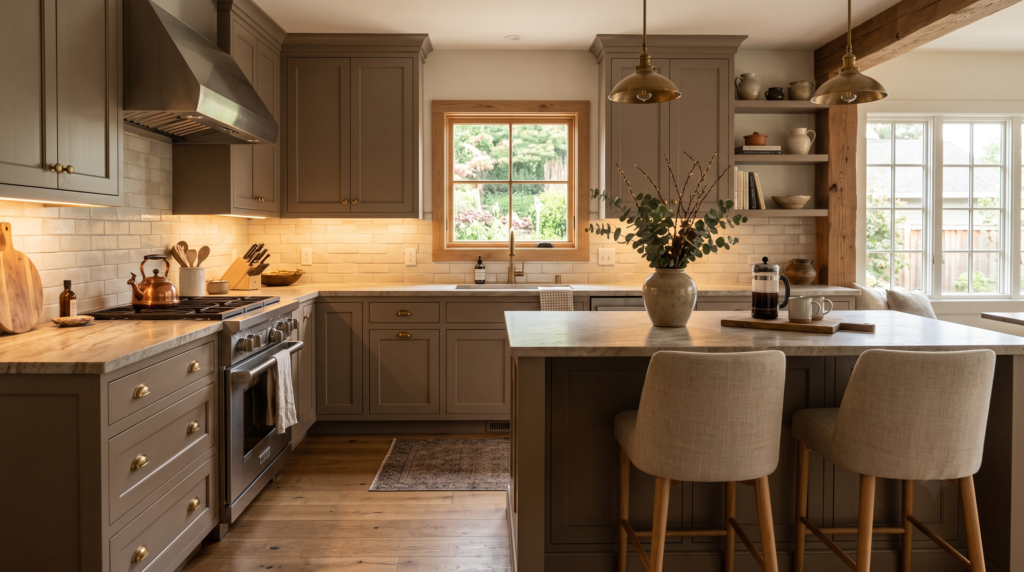
What makes taupe effective as a taupe kitchen paint color is its relationship with light. Unlike cool greys, which can feel flat or even slightly blue in rooms with limited natural light, taupe holds a gentle warmth across different lighting conditions. North-facing kitchens that would look cold in a straight grey respond well to taupe’s warmer undertone. South-facing kitchens benefit too: where strong midday light can bleach a cool grey into near-white, taupe retains its character and warmth.
Taupe kitchen cabinets also offer design versatility that few other neutral finishes can match. The color sits comfortably alongside white, cream, black, wood tones, warm metallics, and even other neutrals, which means it rarely requires careful or complicated coordination with other materials in the room. Countertop materials from white Carrara marble to black granite to warm walnut butcher block all find a natural partner in taupe. Hardware in brass, matte black, chrome, and brushed nickel all work without demanding that a choice be made.
A final advantage is its compatibility with adjacent spaces. Taupe connects naturally to living and dining rooms finished in warm tones, earthy textiles, or wood flooring. A taupe kitchen integrates into a cohesive home interior rather than functioning as a separate design zone. For those navigating warm neutral palettes throughout an open-plan space, taupe is one of the most cohesion-friendly colors available. If you are also considering beige or cream cabinets, those guides explore related warm neutral options worth comparing.
Light Taupe vs Dark Taupe Cabinets
The taupe spectrum runs from pale putty and sandy beige-greys through to deep mocha and coffee-browns, and the tone you choose has a significant effect on how the kitchen feels day to day.
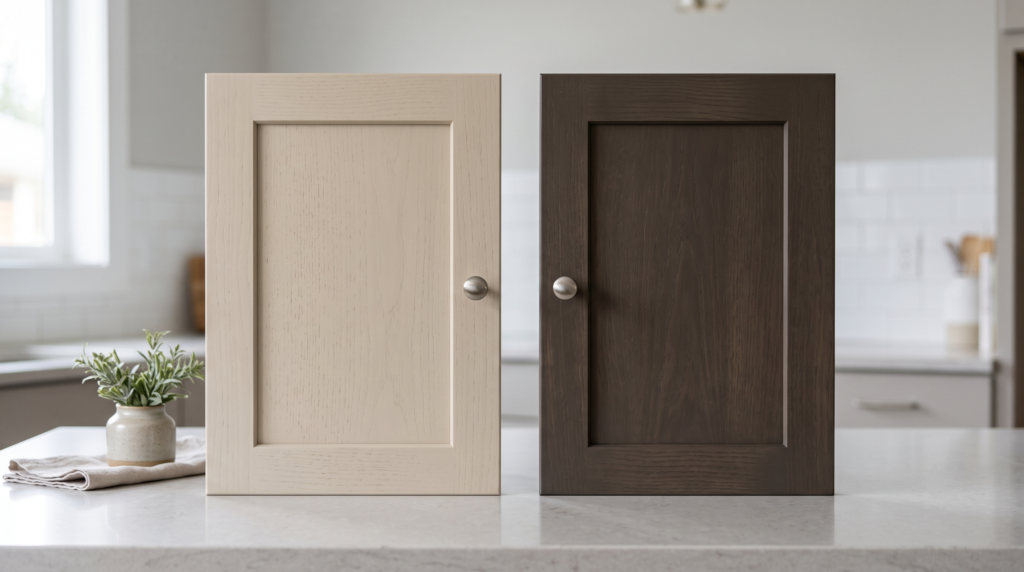
Light taupe cabinets sit at the warmer end of what designers call the sand and putty register. These tones work particularly well in smaller kitchens, where a lighter cabinet color keeps the space feeling open and airy without relying on white. They also suit kitchens with limited natural light: where cool grey would look flat, a light taupe cabinet holds a soft, consistent warmth. Light taupe shaker cabinets are among the most popular choices in this range, with the classic recessed panel profile complementing the gentleness of the tone without adding visual weight.
Dark taupe cabinets have more brown and grey depth, sitting closer to the mocha and tobacco end of the range. These suit larger kitchens where the additional visual weight will not make the space feel closed. Dark taupe is also an effective choice for two-tone kitchen configurations: dark taupe lowers with lighter uppers in cream, off-white, or a paler taupe create a grounded, layered look that feels considered and current.
When choosing between light and dark, the key variables are room size and natural light. As a working guideline: in kitchens smaller than 10 square metres, or in rooms that face north or east, a light taupe cabinet works harder to keep the space feeling open. In larger, better-lit kitchens, dark taupe delivers richness and grounding that lighter tones cannot match.
Taupe shaker cabinets are the most popular door profile across both light and dark ends of the spectrum. The shadow detail created by the recessed frame emphasises the warmth of taupe rather than fighting it, which is why the shaker profile and the taupe palette have become such a consistent pairing in contemporary residential kitchens.
Taupe Cabinet Color Pairings
Taupe is one of the most pairing-friendly cabinet colors in the warm neutral family. The three combinations below consistently deliver strong results across a range of kitchen styles.
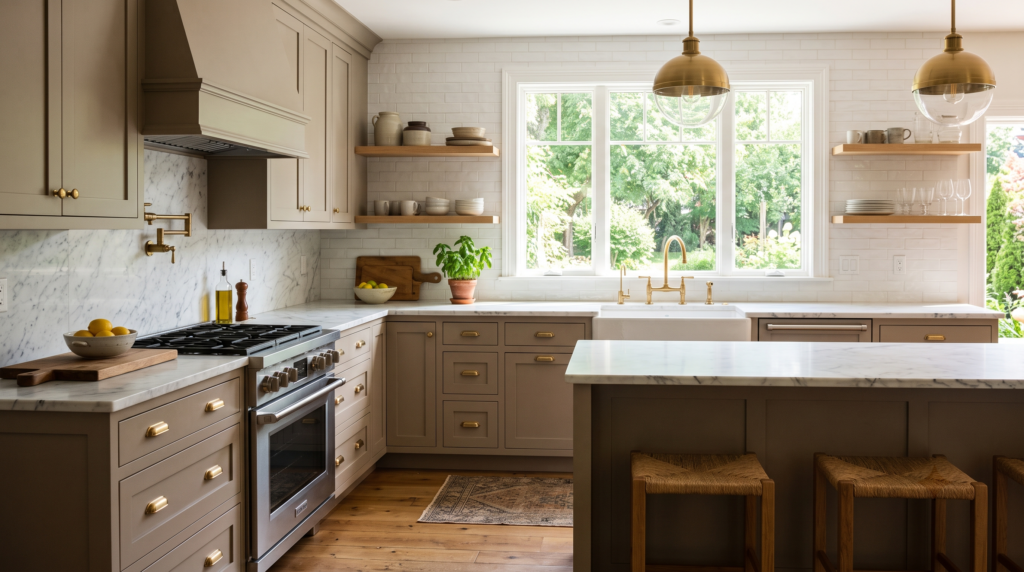
Taupe with White Countertops
Taupe with white countertops is the most versatile combination in this color family. Bright white marble or quartz lifts the cabinet color without competing with it, keeping the kitchen feeling light and well-considered. For taupe kitchen ideas that work across styles from contemporary to transitional, this pairing is the most reliable starting point.
Taupe and Black Kitchen
A taupe and black kitchen uses contrast to create presence without losing warmth. Matte black hardware on taupe doors is the most accessible version: black pulls, hinges, or tap fittings add definition without requiring structural changes. A more committed approach uses a black countertop section or a dark island against taupe perimeter cabinetry for a scheme with real drama.
Taupe with Warm Wood Accents
Taupe and warm wood suits the current interest in organic, layered kitchen interiors. A walnut island or open shelving in oak alongside taupe upper and lower cabinets introduces natural texture without breaking the palette. This is among the more current taupe kitchen ideas and works particularly well in transitional and organic-modern interior schemes.
Taupe vs Greige: What’s the Difference?
Taupe and greige are two warm neutrals that are consistently confused, partly because both occupy the territory between grey and beige, and partly because different paint and cabinet manufacturers use the terms inconsistently across their ranges.
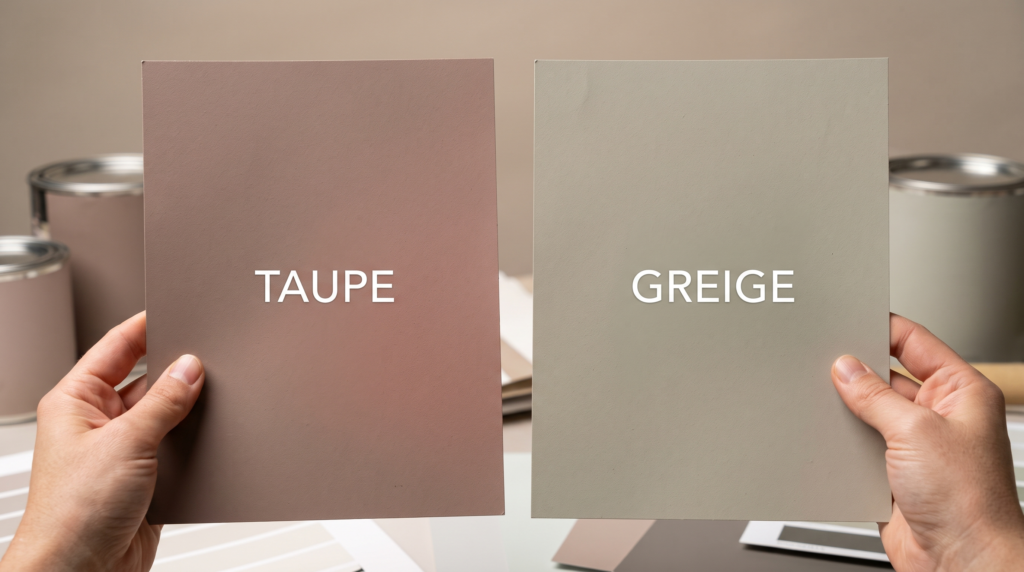
The clearest working distinction is in the undertone. Taupe has a brown undertone with grey added, which gives it a warmer, earthier quality. Greige is a portmanteau of grey and beige and leans in the opposite direction: a grey undertone with beige added, making it feel cooler and closer to the grey family. Hold a taupe swatch and a greige swatch side by side and the difference is immediately visible: the taupe will look warmer and more settled, the greige cooler and lighter.
The taupe vs greige cabinets decision usually comes down to what the kitchen should feel like. If warmth is the priority, taupe is typically the more effective choice. Its brown undertones respond well to warm lighting, natural wood accents, and the kind of earthy material palette that has dominated kitchen design in recent years. Taupe kitchen cabinets work especially well in homes where the kitchen connects to living spaces with wood floors, warm-toned textiles, or stone feature walls.
Greige is the right choice when the goal is to stay within the grey family but avoid the coldness or starkness that a straight grey can introduce. It suits contemporary and Scandinavian-influenced kitchens where the palette leans light and restrained, and the aim is to soften the scheme rather than warm it significantly.
One practical note: the same color can appear as taupe on one paint chart and greige on another, so the label matters less than the undertone you see in context. Always sample your shortlisted cabinet colors in the actual kitchen, under the room’s typical lighting conditions, at different times of day. Taupe kitchen cabinets that look warm and settled at noon can pull cooler in the evening under artificial light, and vice versa. Undertone testing in context is the only reliable method.
Custom Taupe Kitchen Cabinets from Parlun
Parlun manufactures custom taupe kitchen cabinets and a full range of warm neutral finishes for residential and commercial projects worldwide. Available finishes include taupe and greige tones in matte and satin sheens, across Shaker and flat panel door profiles suited to traditional, transitional, and contemporary kitchen designs.
Cabinets are manufactured to custom dimensions, allowing Parlun to accommodate non-standard kitchen layouts, varying ceiling heights, and bespoke island configurations without the constraints of stock sizing. ABS edge banding is applied to all exposed door and panel edges as standard. Hardware is available from established manufacturers, with soft-close mechanisms across all door and drawer configurations.
As a factory-direct producer of kitchen cabinets from China, Parlun offers a quality taupe cabinet finish at a significant cost advantage over European and domestic custom cabinetry suppliers. International project delivery is available, with freight coordinated through Parlun’s established logistics network for residential, commercial, and hospitality projects of any scale.
For finish samples, custom specifications, or a project quotation, contact the Parlun team directly or download the current product catalogue.