casement windows
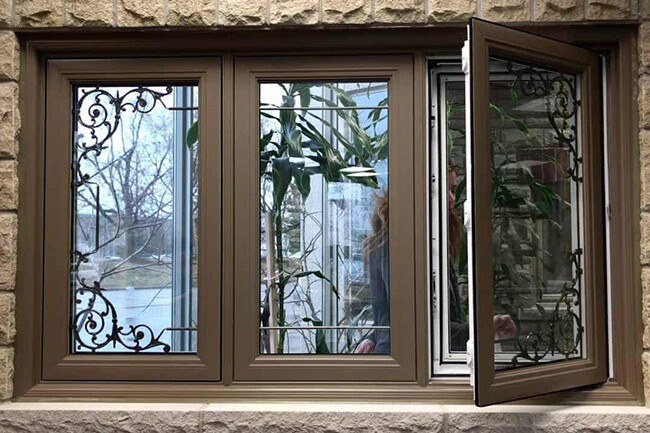
What is a casement window? Casement windows usually describe a two-wing window with a casement developed from the picture window. What is unique about the casement window is the use of a mullion-free profile frame; when both sashes are open, the entire width of the window can be used without the interfering middle mullion. The forend profile ensures that the second window sash can be moved about the first.
Table of Contents
What You Need to Know Before Choosing Casement Windows
Casement windows are the most energy-efficient operable window style because of their compression perimeter seal and multi-point locking mechanism. When the sash closes, it presses against the frame from outside inward, sealing the full perimeter with no air gaps. That is the key difference from a sliding window, which relies on overlapping tracks that always leave small openings for air and sound.
They work best where you want maximum airflow, unobstructed views, or a window above a counter or sink where a crank is easier than pushing a sliding sash sideways. Frame materials cover uPVC casement and aluminum casement with thermal break profiles. Double glazed casement windows with Low-E glass and argon gas filling achieve U-values below 1.2 W/m²K, and triple pane options push that below 0.7 W/m²K for passive house standards. Parlunbuilding supplies custom casement windows from our China factory to builders, developers, and importers across Southeast Asia, Europe, Australia, and the Middle East.
Types of Casement Windows
Standard side-hung casement: The classic outward opening window hinged on the left or right side. Single sash widths typically run 400 mm to 900 mm. Beyond 900 mm, the sash weight stresses the hinges, so a paired or French configuration is the better call. If a wider horizontal opening is what you need, sliding windows handle that better as a single unit.
French casement window: Two sashes hinged on the outer edges that meet in the middle with no center mullion between them. When both sashes open, you get a fully clear opening up to 1800 mm wide. Popular for living rooms, balcony access, and anywhere you want a dramatic unobstructed view.
Awning casement: Hinged at the top and opens outward from the bottom. The open sash acts like an awning that lets air in even during light rain, making it ideal for kitchens and bathrooms.
Hopper casement: Hinged at the bottom, opens inward from the top. Best for basements and small spaces where an outswing is not practical.
Inswing casement: Opens into the room rather than outward. Required in many European high-rise buildings where outward opening windows are restricted above certain floor heights. Also easier to clean since both sides of the glass are accessible from inside.
Casement Window Design Ideas for Modern Homes
Casement windows suit a wide range of architectural styles but they particularly fit modern and contemporary builds because of their clean uninterrupted sightlines.
A flush frame casement sits level with the outer frame so there is no visible step on the facade, giving rendered walls or cladded finishes a flat seamless look. Floor-to-ceiling French casement windows paired with fixed picture panels above create a glass wall effect without a full curtain wall system, a popular detail in modern villas across Southeast Asia and the Middle East.
For commercial projects, slim profile aluminum casement windows with thermal break and narrow frames down to 50 mm sightlines give office and hotel facades a clean linear appearance without sacrificing energy performance. On uPVC casement windows, over 200 RAL colors and dual-color configurations are available, so the exterior face can be anthracite grey or dark green while the interior stays white or carries a wood-effect laminated foil finish.
Casement Windows Pros and Cons
Why Builders and Homeowners Choose Them
Full ventilation across the entire opening: A sliding window opens 50% of its frame area at best. A casement window opens 100%, and the angled sash acts as a wind scoop that funnels a passing breeze directly into the room rather than letting it pass alongside the wall.
Superior energy efficiency: The compression seal combined with multi-point locks that engage at three to five points around the frame gives casement windows the lowest air infiltration rate of any operable window type. Pair this with double glazed casement glazing and argon gas fill and you consistently outperform sliding windows on thermal tests.
Strong security: Multi-point lock systems make it very difficult to force the sash from outside without damaging the entire frame, unlike a single latch point on a sliding window.
Easy operation in hard-to-reach spots: The crank at the base of the frame means you do not need to reach over a counter or push against gravity. Above a kitchen sink, this is a practical advantage that a sliding sash simply cannot match.
The Real Limitations
Exterior clearance required: An outswing window needs unobstructed space equal to its full width on the exterior. This rules them out directly above pedestrian paths, alongside exterior doors, or in tight alleyways.
Single sash width limit: Keep individual casement sashes under 900 mm wide to avoid overstressing the hinges. Wider openings need a French casement or paired configuration.
Crank mechanism needs maintenance: The extension arm and gears need occasional lubrication. On quality units this is a minor task, but it is more upkeep than a sliding window track.
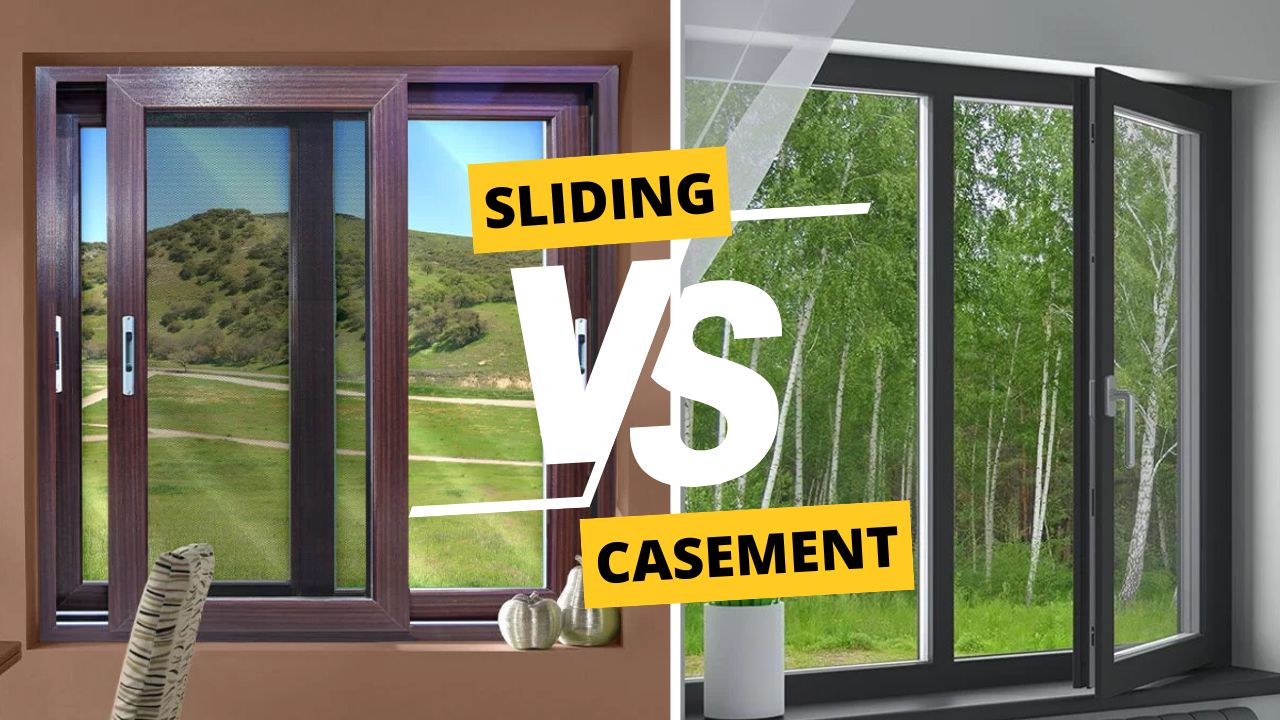
Casement vs Sliding Windows: Quick Comparison
Feature | Casement | Sliding |
|---|---|---|
| Ventilation area | 100% of frame | 50% of frame |
| Energy efficiency | Higher (compression seal) | Lower (track gap) |
| Security | Multi-point perimeter lock | Single latch |
| Exterior clearance needed | Yes | No |
| Best application | Kitchens, bedrooms, modern facades | Wide horizontal openings, tight exterior spaces |
Choose casement windows when energy performance, ventilation, and security are priorities. Choose sliding windows when the opening is very wide, exterior clearance is limited, or the project budget requires a lower-cost window type. Many projects use both strategically. For a deeper breakdown of every difference, read our full casement vs sliding windows comparison guide.
Materials: Aluminum Casement vs uPVC Casement
Aluminum casement with thermal break: The strongest frame option, allowing slim sightlines down to 50 to 60 mm. The thermal break insert between inner and outer aluminum sections reduces heat transfer by up to 30% compared to non-thermal profiles. Best for commercial buildings, high-rise residential, coastal climates, and projects targeting LEED or BREEAM certification.
uPVC casement: A multi-chamber PVC windows profile with steel reinforcement at structural points. A 5-chamber or 6-chamber profile achieves better thermal values than basic profiles. Available in 200 plus RAL colors, wood-effect foil finishes, and dual-color configurations. Does not rust, does not need painting, and lasts over 30 years with minimal maintenance. Best for residential housing, schools, and healthcare buildings where low upkeep is a priority.
Energy Efficiency: Glazing Options for Casement Windows
| Glazing Configuration | Typical U-Value |
|---|---|
| Double pane, air fill | 2.8 W/m²K |
| Double pane, argon gas | 1.1 to 1.3 W/m²K |
| Double pane, argon + Low-E | 0.9 to 1.1 W/m²K |
| Triple pane, argon + Low-E | 0.6 to 0.8 W/m²K |
Low-E (low emissivity) coating is a metallic oxide layer on the inner glass surface that reflects infrared heat back to its source while letting visible light pass through. In cold climates this keeps interior heat inside. In hot climates a different Low-E specification reflects solar heat before it enters the room. Specify the climate and intended use when ordering so the correct coating is applied. See our full breakdown of glazing types and ratings on the energy efficient windows page.
Order Custom Casement Windows from Parlunbuilding
Parlunbuilding manufactures custom casement windows to your exact project drawings. Submit your window schedule with outer frame dimensions, sash configuration, material, glazing spec, hardware finish, and color. Quotation is issued within 2 to 3 business days. Production lead time is 30 to 45 days. CE, AS2047, and NFRC certifications are available by market. Shipping is FOB or CIF, with a standard 40-foot container holding approximately 150 to 300 units. Minimum order is one container. Sample units are available before bulk commitment. If this is your first import order, our how to buy windows from China guide walks through every step from factory selection to port delivery.
Casement windows as desired for individual living
Designed to your requirements, casement windows can be freely combined according to shape, color, size, and material during our communication design process.
The material to choose from is plastic, wood, aluminum, and the combination of wood and aluminum, with PVC casement windows being the most popular and cheapest choice.
You can compensate for casement window disadvantages with the appropriate accessories. For example, you can increase burglar protection with special security fittings.
Choosing the right glass is just as important as selecting the best framing material. In addition to thermal or acoustic glass, windows with decorative glass, such as frosted or patterned, are also available. Parlun offers superior quality casement windows at reasonable prices tailored to your needs.
Frequently Asked Questions
A casement window is hinged on one side and opens outward using a crank handle. Turning the crank pushes a hinged arm that swings the sash open. When closed, the sash presses against the frame from outside inward, creating a compression seal around the full perimeter and making casement windows more airtight than sliding windows.
Yes. The compression perimeter seal and multi-point locks eliminate the air leakage that occurs along sliding window tracks. Combined with double glazed Low-E glass and argon gas fill, casement windows achieve U-values below 1.0 W/m²K, meeting most national building energy codes.
A standard casement has one sash hinged on one side. A French casement has two sashes hinged on the outer edges that meet in the middle with no fixed center post, giving you a fully clear unobstructed opening from frame to frame.
Exterior clearance is required for the outswing sash, single sash width should stay under 900 mm, and the crank mechanism needs occasional lubrication. Unit cost is also slightly higher than comparable sliding windows.
Yes. Inswing casement windows open into the room, required in many European high-rise buildings where outward opening is restricted. They are also easier to clean since both glass surfaces are accessible from inside. Both configurations are available at Parlunbuilding.
Single sash widths typically range from 400 mm to 900 mm, heights from 600 mm to 2000 mm. French casement configurations cover 1000 mm to 1800 mm total width or larger on custom orders. Parlunbuilding manufactures to your exact drawing dimensions.
Aluminum with thermal break gives slimmer sightlines, higher strength, and better corrosion resistance for commercial and coastal projects. uPVC offers better natural frame insulation, lower cost, and more color options with minimal maintenance for residential and low-rise buildings.
Production is 30 to 45 days from order confirmation. Ocean freight adds 5 to 15 days to Southeast Asia and 20 to 35 days to Europe, Australia, or the Middle East. Total lead time is typically 45 to 90 days depending on destination.
CE certification for European markets, AS2047 for Australia, and NFRC documentation for North America. All production runs under ISO quality management standards.
Yes. Double glazed casement windows with argon gas fill are standard on Parlunbuilding bulk orders. You specify the glass configuration, Low-E coating position, gas fill type, and spacer. All specs are confirmed in the technical sign-off before production starts.


Contact us to get the quote and the catalog for free
Please fill in the area marked with *
Of course, if you have more detailed information and want to tell our experts, you can also fill in the form completely