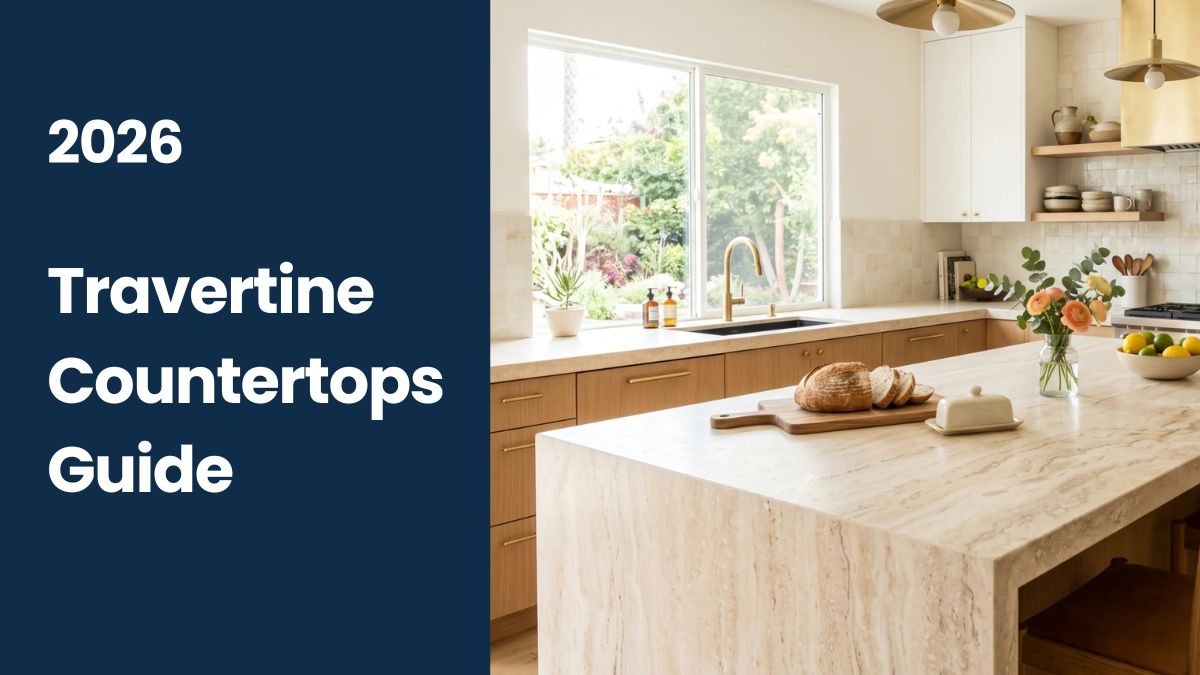
Travertine countertops bring a warmth that few natural stones can match. Shaped by mineral springs over thousands of years, travertine was used in Roman architecture and is now establishing itself as a premium choice in kitchen design. Each travertine slab countertop carries its own natural veining and pitting, an aged character that suits everything from traditional Tuscan kitchens to contemporary transitional spaces. Travertine kitchen countertops suit designers seeking natural stone warmth over cool, uniform precision.
What Is Travertine?
Travertine is a form of limestone that forms when calcium carbonate precipitates from mineral-rich spring water, typically around geothermal hot springs and rivers. The process produces a stone with characteristic natural pitting and veining, giving each travertine slab countertop a surface that no two pieces replicate exactly. Available in a range of tones including ivory, cream, walnut, and gold, travertine has a history stretching back millennia: it was used in the Colosseum, Roman bath houses, and architectural facades across the Mediterranean.
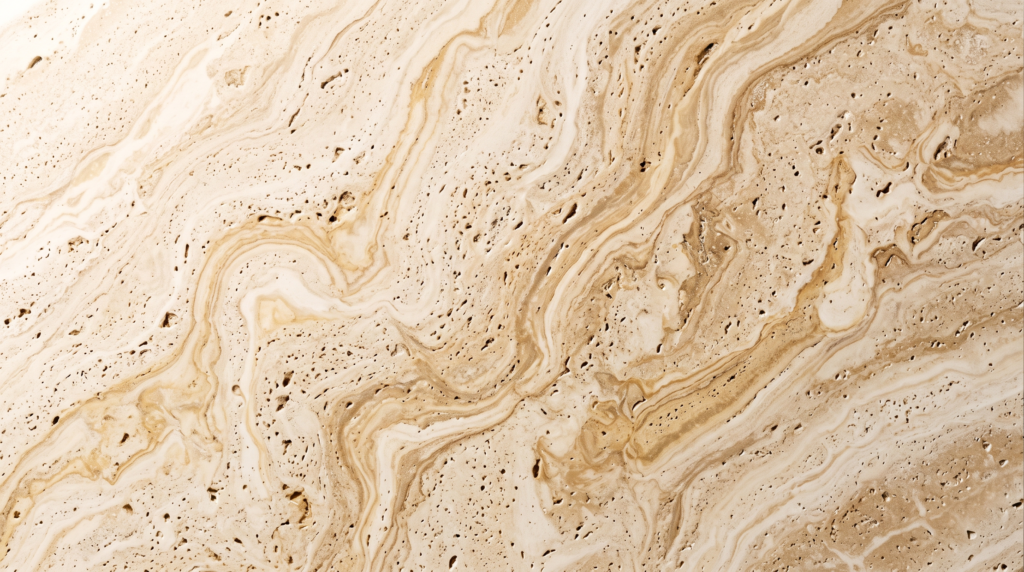
In kitchen design, travertine countertops are valued for their warmth and depth. Unlike engineered quartz or solid surface materials, travertine carries the visible record of its formation: subtle tonal movement, organic patterning, and a material presence that communicates quality. Premium residential and hospitality projects are increasingly specifying travertine as a warmer, slightly more accessible alternative to marble.
Travertine is quarried primarily in Italy, Turkey, Iran, and Mexico. Italian travertine, particularly from Tivoli near Rome, is considered among the finest. The stone is available in slab format for countertops, with 20mm and 30mm thicknesses most common for kitchen applications. As each slab carries its own tonal variation, viewing the stone in person at a stone yard before ordering is always recommended.
Travertine Countertop Pros and Cons
Before specifying travertine for a kitchen, it pays to weigh the stone’s genuine strengths against the care it requires.
Pros of Travertine Countertops
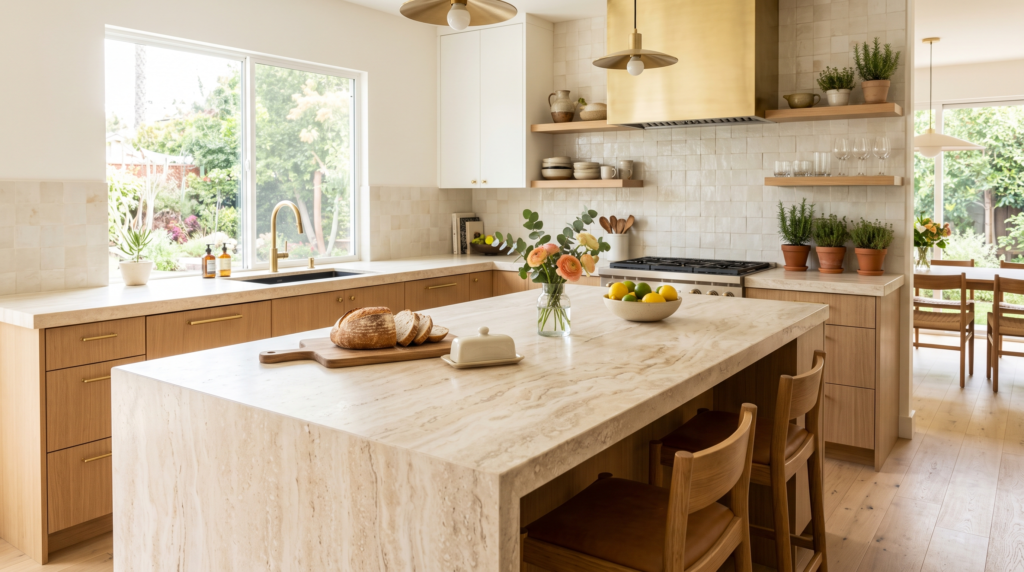
The natural beauty of travertine is its most compelling advantage. Each surface is unique, with warm tones and organic movement that manufactured materials cannot replicate. On a honed finish, minor scratches and everyday wear tend to blend into the texture, making travertine kitchen countertops more forgiving than polished stone in a busy kitchen. Travertine is also generally more affordable than marble, offering comparable natural luxury at a lower cost per square metre.
Cons of Travertine Countertops
Travertine is porous, which means acidic liquids (citrus juice, wine, vinegar, coffee) can etch and stain the surface if left unattended. The natural pitting requires filling if you want a smooth, hygienic working surface. Compared to engineered stone, travertine is heavier and less dimensionally consistent, which can add complexity to installation. Reviewing travertine countertop pros cons carefully before committing ensures the stone suits your kitchen’s level of daily use.
Travertine vs Marble: Which Is Better for Countertops?
Both travertine and marble are natural stones with genuine character, but they differ in temperament and in what they ask of the people living with them.
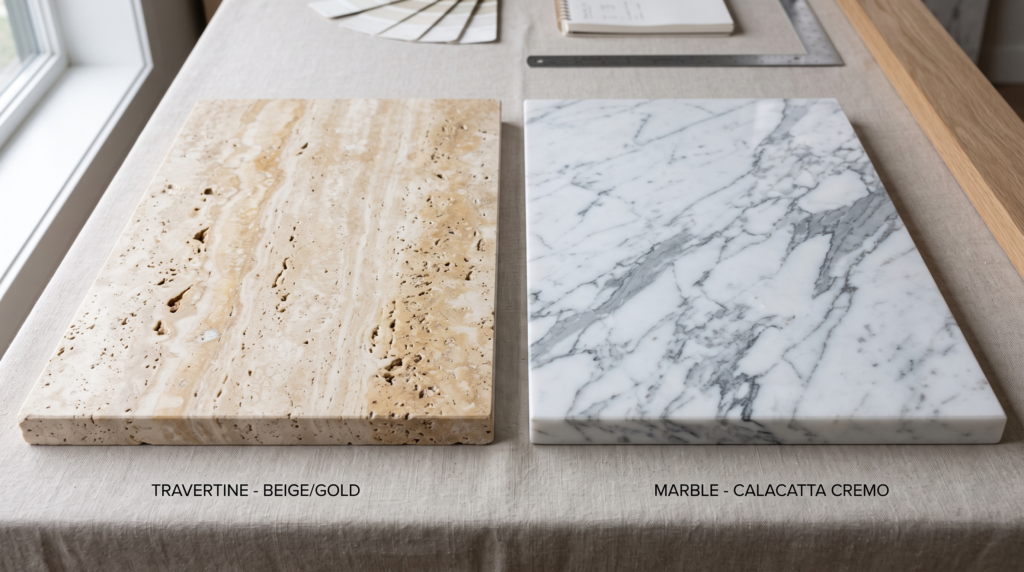
Marble is harder and denser, with a more uniform veining pattern that suits formal, classical aesthetics. The travertine vs marble question often comes down to palette and personality: marble leans cool with grey and white tones, while travertine runs warm with ivory, gold, and walnut hues. For a kitchen aiming at warmth and organic texture rather than formal elegance, travertine is usually the more fitting choice.
In terms of porosity, both stones require regular sealing and are vulnerable to etching from acids. Travertine is softer, making it marginally more susceptible to scratching, but on a honed finish this wear integrates into the surface texture rather than standing out as visible damage. Both materials require a level of daily attentiveness that engineered stone does not.
On cost, travertine countertop cost is generally lower than marble across most slab grades. The gap widens for premium marble varieties such as Calacatta or Statuario, where travertine may come in at considerably less for a comparable visual warmth. For clients who want the organic movement of natural stone at a more accessible price point, travertine countertops make a strong case.
Travertine Countertop Finishes: Honed, Polished, and Tumbled
The finish chosen for a travertine countertop significantly affects how the stone looks, feels, and performs in daily kitchen use. Three finishes are commonly used.
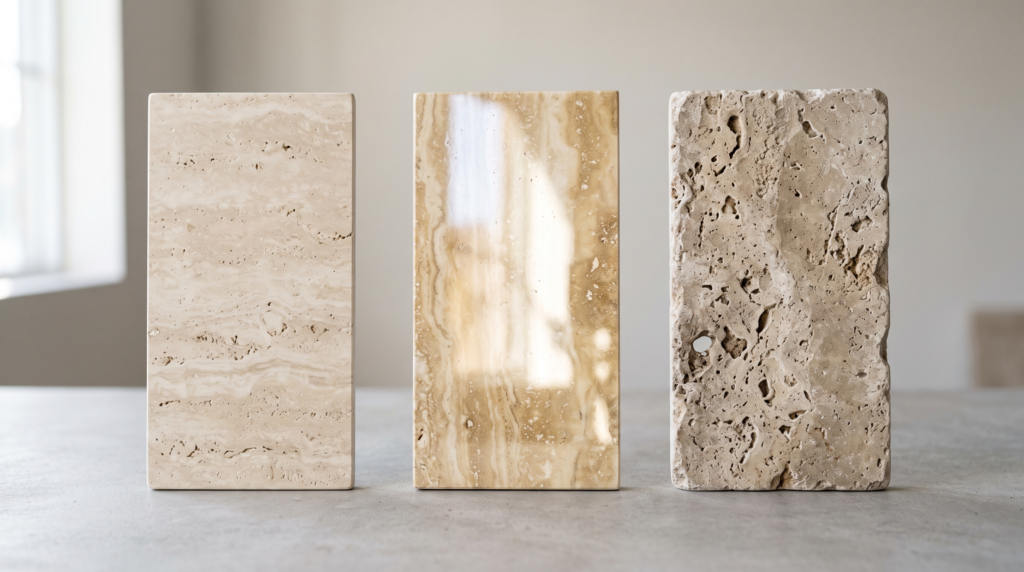
Honed is the most widely specified finish and the one most kitchen designers recommend for travertine. The surface is ground flat to a smooth, consistent matte that brings out the stone’s natural warmth without added reflectivity. A honed travertine countertop handles daily wear more gracefully than its polished equivalent: scratches tend to disappear into the matte surface rather than catch the light, and the overall appearance holds up well in a working kitchen over time.
Polished travertine has a reflective, glassy surface that draws out the veining and tonal variation with real intensity. In large-format slabs under directional lighting, polished travertine is visually striking. The drawback is practical: it shows etching, water marks, and fingerprints more readily than a honed finish, which can make it demanding in a kitchen that sees genuine daily use.
Tumbled travertine is processed to create an aged, rougher surface with softened edges and pronounced texture. It is rarely specified for countertops in contemporary kitchens but works well in rustic, Mediterranean, or heritage schemes where an authentically weathered material is the design intent. It is more commonly used for flooring and backsplash tile in these settings.
For most travertine kitchen countertops, honed remains the professional recommendation on both practical and aesthetic grounds.
How to Seal and Maintain a Travertine Countertop
Travertine countertop sealing is not optional. It is the most critical step in protecting the stone, and it begins before the countertop enters daily use. Apply a penetrating impregnator sealer on installation, and plan to re-seal annually. In kitchens with high cooking frequency, re-sealing every six months provides more reliable protection.
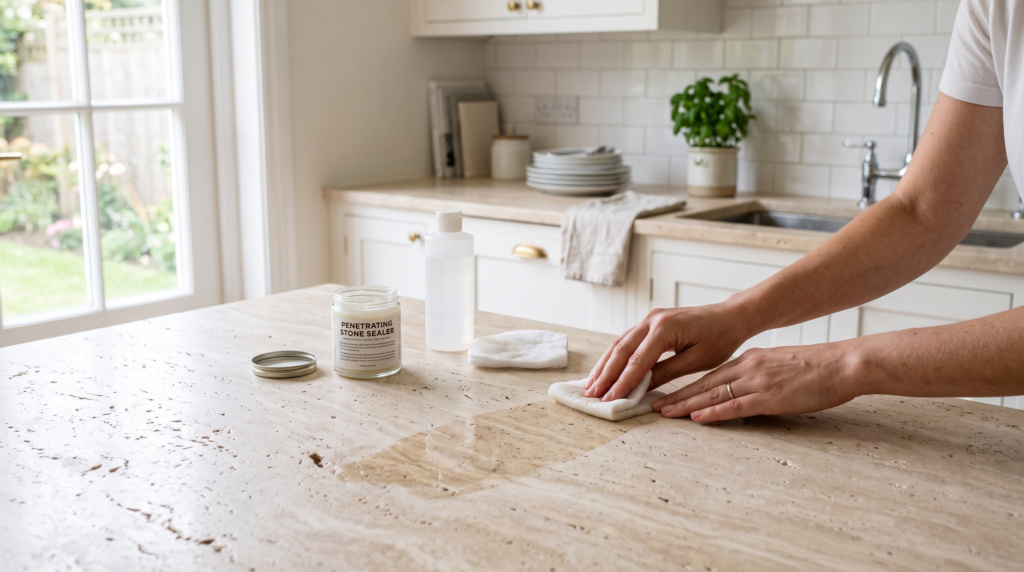
Day-to-day care requires consistency. Wipe spills as soon as they occur. Anything acidic, including citrus juice, wine, vinegar, and coffee, should be cleaned immediately, as these liquids etch the surface even through a sealer if left for more than a few minutes. For routine cleaning, use a pH-neutral stone cleaner only. Bleach-based sprays, abrasive powders, and steel wool all degrade both the sealer and the stone surface beneath it.
If the travertine is supplied with unfilled pitting, use a colour-matched travertine filler to create a smooth, hygienic working surface before sealing. This filler can be reapplied as needed over the life of the countertop. Periodic professional honing or polishing can also restore travertine kitchen countertops that have accumulated significant etching or surface wear.
With consistent care and annual travertine countertop sealing, the stone develops a rich patina that deepens in character over time rather than declining in appearance.
Travertine with White Kitchen Cabinets
Few combinations in kitchen design have the staying power of travertine with white cabinets. The warm ivory and gold tones of travertine sit naturally against white or off-white cabinetry, producing a palette that feels sophisticated without being cold. Where white marble and white cabinetry can veer towards the clinical, travertine brings enough inherent warmth to keep the space feeling grounded and inviting.
This pairing works particularly well with Shaker-style cabinetry, where the clean recessed-panel profiles complement the organic texture of the stone without competing with it. Traditional and transitional cabinet styles are also well matched, as both share travertine’s quality of feeling timeless rather than trend-driven.
Hardware is worth considering carefully. Brass and unlacquered bronze both echo the warm undertones in most travertine tones, reinforcing the palette naturally. Matte black hardware creates a sharper contrast that works well in more contemporary schemes. Polished chrome tends to cool the palette and is generally less harmonious with travertine’s warmth.
For flooring, carrying travertine tiles through from the countertop creates a cohesive, layered material story. Alternatively, warm white oak flooring or light limestone keeps the scheme harmonious without feeling repetitive. Pale linen-toned walls or warm white plaster complete a kitchen where travertine countertops serve as the natural material anchor.
Travertine with white cabinets suits a broad range of architectural styles, from Californian Spanish revival and Tuscan farmhouse to clean-lined transitional kitchens looking for a natural stone with genuine warmth and character.